
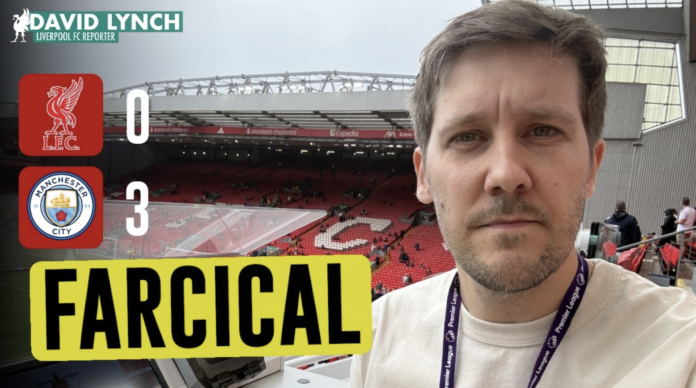

FIVE KEY TAKEAWAYS FROM DAVID LYNCH
A 3–0 defeat at Anfield usually leaves little room for encouragement. David Lynch’s assessment of Liverpool’s loss to Manchester City, however, was more nuanced than the scoreline might suggest.
Speaking in his post-match video, Lynch separated the result from the performance. He saw promise in Andoni Iraola’s approach, encouraging contributions from Ryan Gravenberch and Bradley Barcola, and a contest fundamentally altered by a red card.
His strongest criticism concerned the uncertainty surrounding Manchester City and the Premier League itself. For Liverpool, though, his message was that disappointment should not obscure the evidence of progress.
1. Manchester City uncertainty overshadows the contest
Lynch began with the issue hanging over the fixture before a ball was kicked.
He described the situation surrounding Manchester City as “a complete and utter mess”, arguing that the unresolved consequences of the club’s financial case made it difficult to know how to interpret the competition.
That criticism, he stressed, preceded Liverpool’s defeat. He had already addressed the subject on his Substack before the match, anticipating that any subsequent complaint might be dismissed as sour grapes.
For context, City have appealed against the independent commission’s findings and continue to contest them, as reported by Associated Press.
Lynch’s concern was about the uncertainty that remains while matches continue. His suggestion that results could eventually be expunged was a possible scenario he raised, rather than an announced outcome.
He also questioned the siege mentality surrounding City. In his view, defiant celebrations and gloating from sections of the away support risked eroding sympathy for supporters who had no responsibility for the club’s conduct.
2. Liverpool’s performance deserved more credit than the scoreline
For all that frustration, Lynch was clear that Liverpool’s football required its own assessment.
He had approached the game with limited confidence because of the absences of Dominik Szoboszlai, Cody Gakpo and Alexander Isak. Removing that much quality from an attack changes what a team can reasonably expect to produce.
Yet Liverpool’s intensity impressed him. Their aggressive marking, pressing and ability to force turnovers helped restrict City, particularly early in the match.
“I was pleasantly surprised with the performance,” he said.
Liverpool also created openings that could have changed the afternoon, most notably the chance Barcola fashioned for Lewis Koumas. Lynch felt the hosts were producing the better moments even without creating a steady stream of opportunities.
His wider point was about expectations. Iraola’s side are still developing. They cannot simply inherit the authority of Jürgen Klopp’s best Liverpool teams because the fixture is being played at Anfield.
Before the dismissal, Lynch saw enough intensity and organisation to suggest the manager has something worth building on.
3. Gravenberch’s dismissal changed Liverpool’s task
The red card was the decisive interruption to that progress.
Lynch considered Gravenberch’s first booking, following the incident involving Elliot Anderson, particularly unfortunate. He questioned whether the contact justified a yellow card and felt the apparent pain suffered by the City midfielder had influenced the decision.
His assessment of the second booking was less forgiving.
With Jérémy Doku accelerating on the counterattack, Gravenberch’s movement across him invited a decision. Lynch still considered the dismissal harsh overall, but acknowledged that the second challenge was harder to defend.
“He has to be maybe smarter around that second yellow card,” he said.
That distinction matters. Liverpool could feel aggrieved by the first booking while recognising that a player already cautioned must manage the next challenge carefully.
Once Liverpool were reduced to ten men, maintaining their pressing approach became far more difficult. City could introduce quality from the bench and exploit the changing conditions. The final score reflected a game that had become very different from the earlier contest.
4. Gravenberch offered a reminder of his quality
The dismissal should not erase everything that preceded it.
Lynch highlighted six duels won from 11 and four successful dribbles from four attempts as evidence of Gravenberch’s contribution. This was a midfielder competing effectively and carrying the ball with purpose.
That mattered after a difficult start to the season had prompted questions about his place in Iraola’s plans.
Lynch rejected the idea that the Dutchman had nothing substantial left to offer. His performance showed why Liverpool will still need him, even if his afternoon ended with a costly mistake.
There is room for both conclusions. Gravenberch played well enough to strengthen his case for involvement and failed to navigate the disciplinary situation successfully.
Liverpool need the quality he showed before the sending-off, accompanied by better judgement when the next risky challenge presents itself.
5. Barcola’s creativity gives Iraola something to develop
Barcola provided another reason to look beyond the scoreline.
His pass for Koumas, slipped through with the outside of his boot, was the clearest example of his attacking quality. Lynch believed a finish there could have put Liverpool on course to win.
The supporting numbers were encouraging too. Lynch credited Barcola with two chances created, three successful dribbles from six attempts, seven ground duels won from 12 and three tackles.
Those defensive contributions were especially relevant to the demands of Iraola’s football. Barcola was helping Liverpool compete as well as trying to create.
There remains work to do. Lynch felt the winger could exploit his pace more often, particularly when opportunities arose to attack space behind City’s defence. The physical demands of the Premier League also remain part of his adaptation.
Nevertheless, there was enough invention and endeavour to encourage. Liverpool left Anfield with a painful defeat, but Lynch’s verdict was that the performance contained useful foundations. Turning those moments into a complete display is the next challenge.