
Gabriel Martinelli’s message after the moment that stopped a game
There are moments in football that feel louder than the scoreline. They arrive unannounced, stretch the emotional fabric of a match, and linger long after the final whistle. Arsenal’s goalless draw with Liverpool was one such evening, defined less by tactics or territory and more by an uncomfortable flashpoint involving Gabriel Martinelli and Conor Bradley.
Late in stoppage time, with tension already running high, Martinelli attempted to move Bradley off the pitch after the Liverpool defender went down injured near the touchline. In the heat of a frantic finale, the Arsenal forward appeared to assume time-wasting. What followed was brief but jarring: a confrontation, yellow cards, and a sense that the match had tilted away from football and towards something more raw.
The incident, replayed endlessly across screens and social feeds, became the defining image of the night. Yet what followed afterwards mattered just as much.
How the flashpoint unfolded
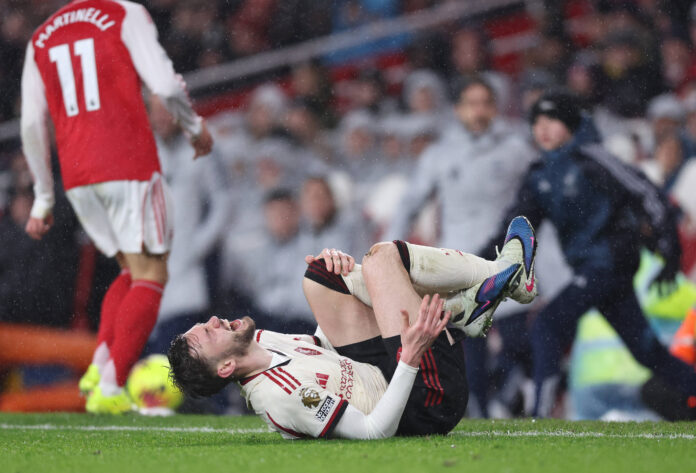
Bradley fell awkwardly close to the sideline as the game entered its final moments. Martinelli first threw the ball towards him, then attempted to usher him back onto the pitch. Liverpool players reacted immediately, protecting a teammate who was clearly in distress. The referee intervened, booking both Martinelli and Ibrahima Konaté as tempers flared.
Bradley was eventually carried off on a stretcher, visibly shaken, his injury serious enough to halt the game’s momentum entirely. It was one of those moments that puncture the illusion football tries to maintain: that urgency and empathy can always coexist at full speed.
After the match, Liverpool head coach Arne Slot sought to contextualise the episode rather than inflame it.
“I don’t know Gabriel Martinelli but he comes across as a nice guy,” Slot said. “I think the problem for him is – and that’s the problem in general in football – is that there is so much time-wasting and players pretending they are injured in the final parts of the game or during the game that you can then sometimes be annoyed if you want to score a goal that you think that player is time-wasting.”
Slot went on to explain that expectation, perception, and emotion collide in those moments. “You cannot expect from Martinelli that he thinks so clear in the 94th minute,” he added. “I am 100 per cent sure if he knew what the injury might be that he would never do that. But it doesn’t look great if he has the injury which we fear he might have.”
Context, pressure and misjudgement
Football increasingly asks players to make instant moral judgements under extreme physical and psychological stress. Time-wasting is policed socially as much as it is by referees, and frustration builds quickly when seconds feel precious. Martinelli’s reaction sat within that broader tension: a product of urgency rather than malice.
That does not excuse the action, but it does explain it. Matches at this level are played on a knife edge, where empathy can be momentarily eclipsed by desperation. The modern game rarely allows players the benefit of pause.
What matters, then, is how players respond once the noise fades.
Martinelli’s full message to Bradley
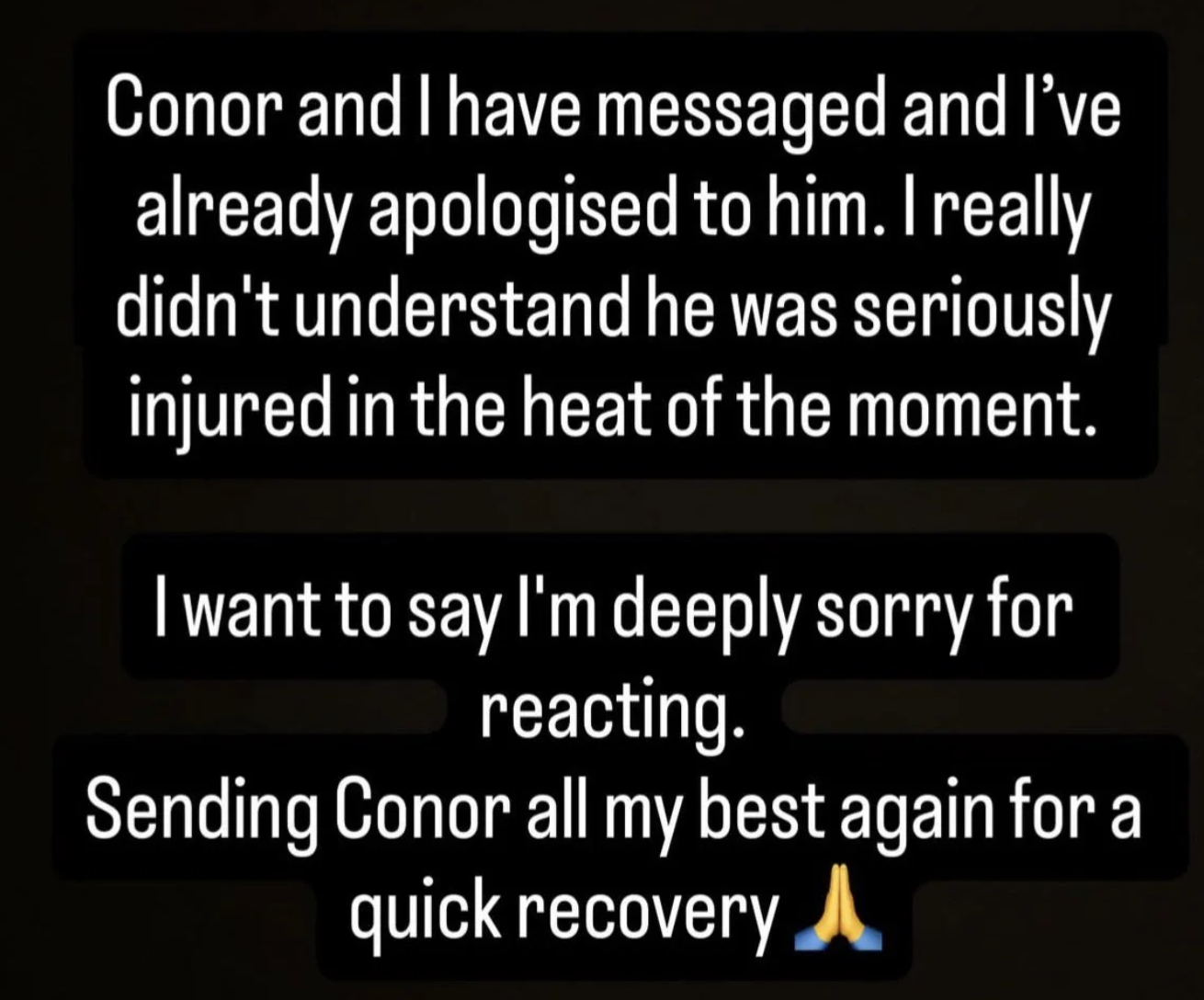
Within hours, Martinelli addressed the incident directly on social media, issuing a clear and unambiguous apology. His message read:
“I really didn’t understand he was seriously injured in the heat of the moment. I want to say I’m deeply sorry for reacting. Sending Conor all my best again for a quick recovery.”
There was no deflection, no conditional phrasing, no attempt to dilute responsibility. It was a message that acknowledged error without theatrics, aimed squarely at the player most affected.
In a sport often dominated by half-apologies and strategic silences, the simplicity of Martinelli’s words carried weight.
What the episode ultimately says about football
This was never really about Arsenal or Liverpool, or even about a single winger’s lapse in judgement. It was about the pressure points of elite football, where urgency and humanity sometimes collide.
Bradley’s injury shifted the conversation away from rivalry and towards welfare. Martinelli’s message ensured it did not drift into something uglier. Together, the two moments form a complete story: misjudgement followed by accountability.
The original source of the incident and subsequent reaction was reported by DaveOCKOP, whose coverage detailed both the on-field confrontation and the apology that followed.
Football will continue to produce moments like this, because it is played by humans operating at their limits. What defines those moments is not their existence, but the response that comes after. On this occasion, a brief lapse was followed by a clear message — and sometimes, that is where the real resolution lies.