


Slot praises beauty and battles as Barnsley push Liverpool to think harder
Liverpool’s passage into the fourth round of the FA Cup was sealed with a 4-1 win over Barnsley, but Arne Slot made it clear afterwards that this was not a night to be reduced to a scoreline alone. It was a game that demanded patience, precision and, above all, solutions. In that sense, it fitted neatly into the wider story of Slot’s early months at Anfield: progress, but rarely without friction.
As reported originally by Liverpoolfc.com in Slot’s post-match press conference following the FA Cup tie, the head coach was quick to separate result from performance. Advancement mattered. The manner of it, however, remained open to analysis.
Slot described it simply: “A good win. That’s not the performance, that’s the result. We wanted to go into the next round, that’s what we did.”
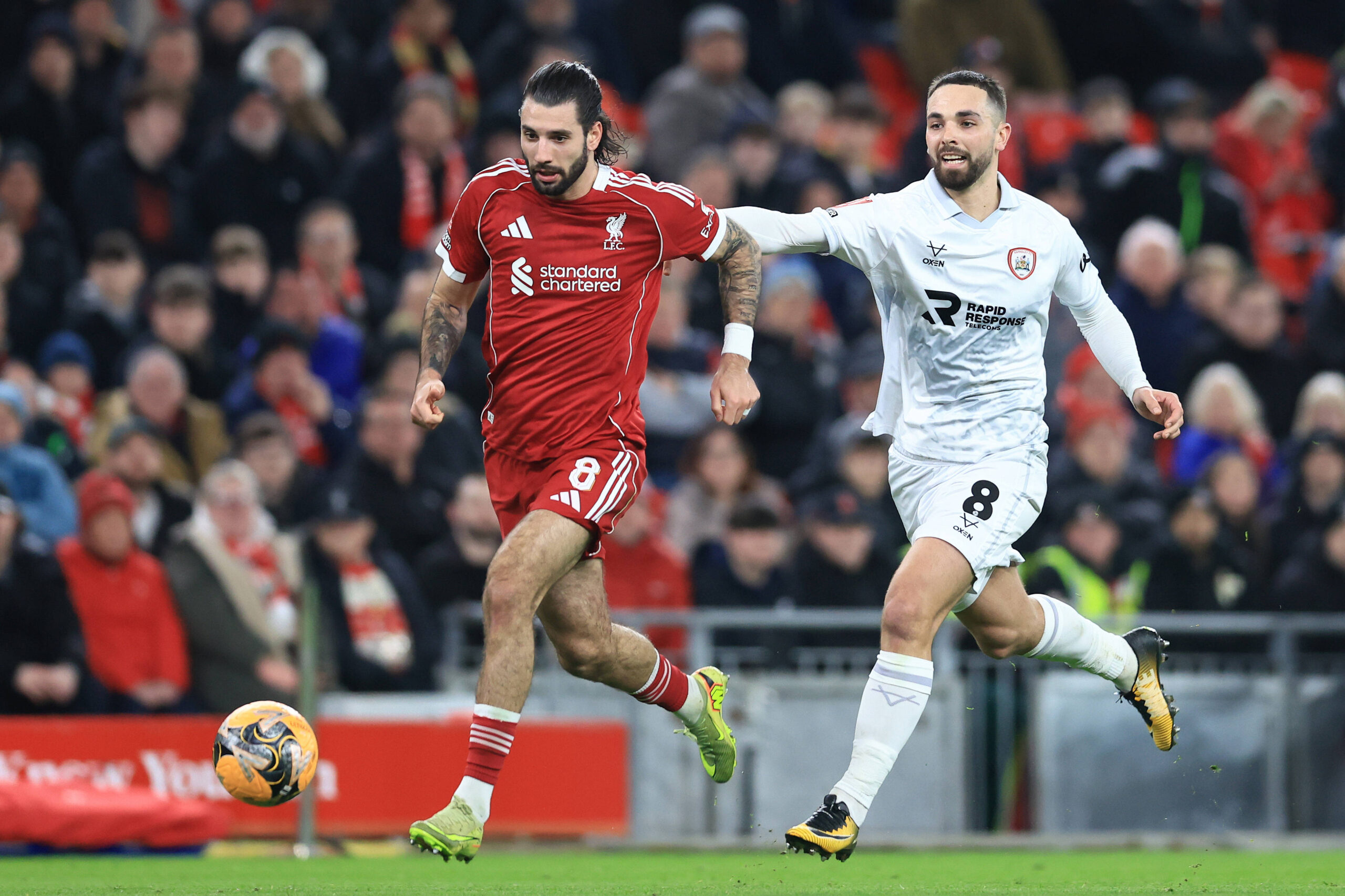
Goals as tools rather than decoration
Four goals should always bring satisfaction, yet Slot framed them less as moments of celebration and more as evidence of problem-solving. Barnsley arrived with a low block and an altered system, forcing Liverpool to improvise.
“Four beautiful goals,” Slot said. “Shots from outside the box; it’s not always easy to unlock a low block, for any team in the world but definitely also not for us. You have a few weapons to do so. Set-pieces, as we see so many times, especially in the Premier League. A shot from outside the box, a one-v-one.”
Slot carefully walked through each attacking solution on show. “We saw today a shot from outside the box and a one-v-one from Jeremie Frimpong. And in the end we saw with the third one some individual skills from Curtis, Hugo and Flo which led to a good goal. So yeah, some good goals.”
It was an analysis that revealed how Slot sees attacking football: not as artistry for its own sake, but as a set of adaptable answers to changing questions.
Control, complacency and concession
Yet the evening carried a familiar irritation. Liverpool conceded once more from a position of comfort, something Slot acknowledged has become an unwelcome theme.
“It doesn’t help to concede a goal if you’re 2-0 up,” he said. “Normally when you’re 2-0 up, the other team is close to maybe accepting their loss, especially if you can keep going and have the ball so much.”
The momentum shift mattered. “But if you then give away an easy goal, which we have done so many times this season, then it’s a big difference in mindset for the other team… So, it’s definitely not helpful for us.”
Slot did not single out individuals publicly, but he was clear on the collective consequence. “Even tonight we could see a lot of things being the same as we’ve seen so many times this season.”
Barnsley adaptation earns respect
While Liverpool wrestled with themselves, Slot was generous towards the opposition. Barnsley’s flexibility, in particular, stood out.
“They can be proud of themselves,” he said. “How difficult they made it for us. A game plan that looked very similar to a lot of teams that are coming here.”
Slot admitted that preparation often becomes obsolete. “I think 28 of my pre-match meetings I could just throw in the bin. I think only once or twice the team did what they did the 20 weeks before.”
Barnsley’s shift from their usual approach forced Liverpool into a longer struggle. “By doing that they made it really difficult for us… For a long time they were in the game because I think it was the 84th minute when we scored the 3-1. It’s a compliment to them.”
Depth, youth and managing expectation
The closing stages allowed Liverpool’s quality to assert itself, aided by experience from the bench and youthful energy on the pitch. Slot highlighted the balance required.
“It is, for every team, very important to have strength in depth in your squad,” he said, explaining why he resisted wholesale rotation. “I think it showed tonight that we needed a lot of first-team players to win this game.”
He also reflected on the demands placed on younger players. “I assume and think and expect it’s cramp,” Slot said of Rio Ngumoha. “It tells Rio that a Premier League game is more intense than this one… But that’s completely normal for a 17-year-old.”
For Slot, the night ultimately sat somewhere between reassurance and reminder. Liverpool scored goals of quality, overcame resistance and moved forward in the competition. Yet the margins, the lapses, and the need for constant adaptation remain central to his thinking.
In the FA Cup, progress is currency. Under Slot, reflection appears just as valuable.