
Liverpool Rise to the Summit of the Deloitte Money League as England’s New Financial Powerhouse
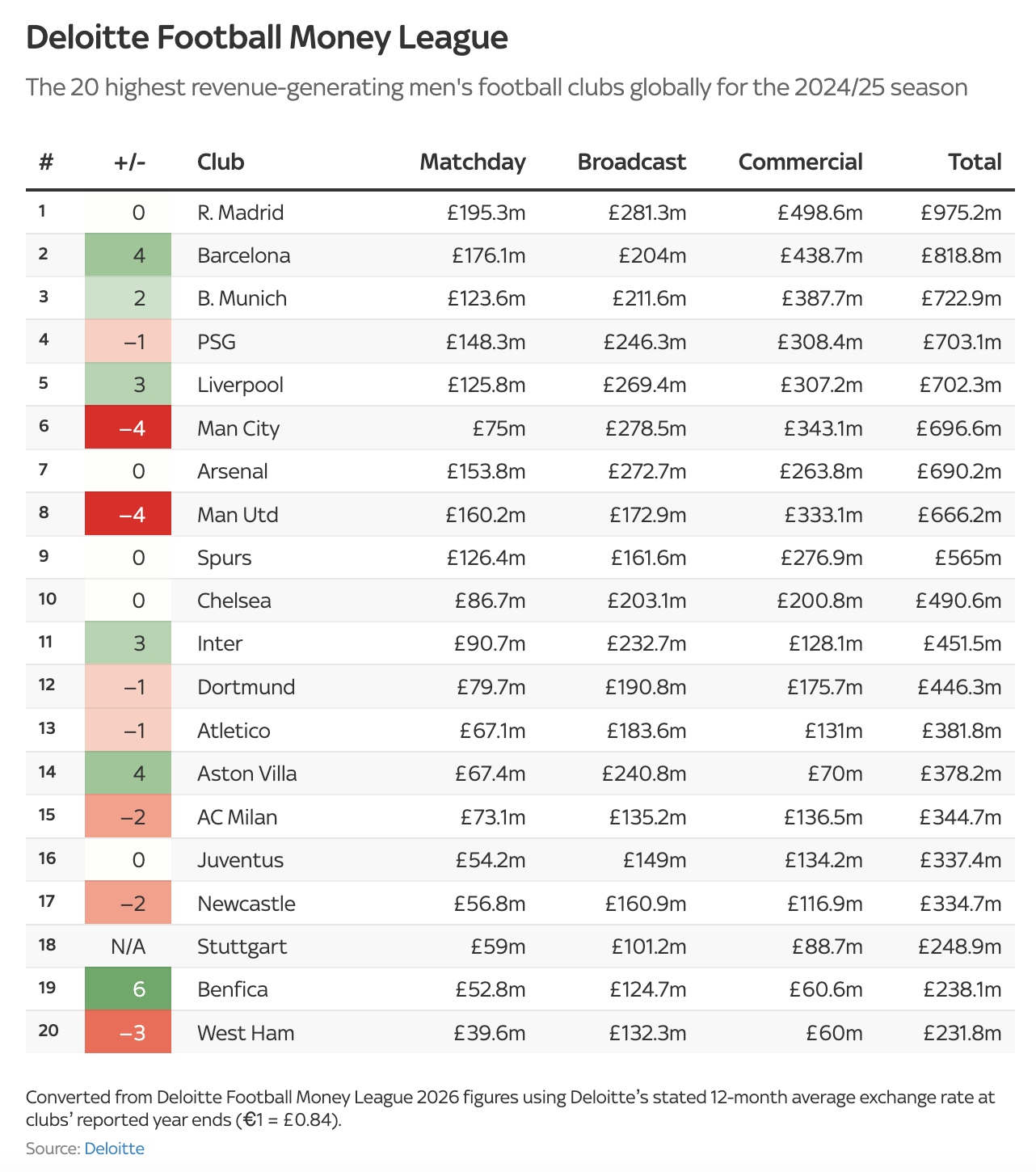
Liverpool’s ascent to the top of the Deloitte Money League is more than a balance-sheet victory. It is a marker of cultural reach, competitive relevance, and institutional confidence in an era where football’s economic map is constantly redrawn. For the first time, the club have become the highest-earning English side, generating €836m (£702m) in revenue, confirming their status as the country’s top ranked English club in financial terms.
According to reporting by BBC Sport journalist Mandeep Sanghera, whose analysis of Deloitte’s latest figures forms the original source of this story, Liverpool’s rise comes on the back of Premier League success and sustained commercial growth. But beneath the headline numbers lies a deeper narrative about how elite football now functions: as a fusion of performance, branding, infrastructure and global attention.
This is not simply about winning trophies. It is about winning relevance.
Liverpool’s Financial Surge Reflects a New Era of Stability
Liverpool’s position in the Deloitte Money League has been years in the making. The club’s modern transformation began with structural reform, data-led recruitment, and a renewed emphasis on sustainability. Under this model, success was never designed to be fleeting.
Winning the 2024–25 Premier League provided the sporting catalyst, but the foundations had already been laid. Matchday income has grown through stadium expansion and optimisation. Commercial revenue has surged through strategic sponsorships and retail performance. Broadcasting income continues to rise through consistent participation in elite competitions.
Deloitte’s figures show that commercial income across Europe’s biggest clubs now outweighs traditional gate receipts. Liverpool’s ability to adapt to this shift explains their current position. They have not chased financial shortcuts. Instead, they have built a scalable model capable of surviving cycles of transition.
In modern football, patience is now a competitive advantage.
Deloitte Money League Shows Changing Power Structures
Liverpool’s elevation comes at a time when old hierarchies are shifting. Manchester United, once the undisputed commercial leaders, have slipped to eighth. Manchester City have dropped to sixth. Traditional dominance no longer guarantees financial supremacy.
Real Madrid remain Europe’s benchmark, generating over €1.2bn, while Barcelona and Bayern Munich continue to thrive. Yet the English landscape is becoming more fluid. Arsenal, Tottenham and Chelsea remain within touching distance, while clubs such as Aston Villa and Newcastle United are building momentum.
The Deloitte Money League no longer reflects merely historical size. It rewards operational efficiency, strategic vision and global resonance.
Liverpool’s presence among Europe’s elite reflects their ability to compete beyond domestic borders. Their brand travels. Their narratives resonate. Their matches matter.
In an age of constant digital consumption, attention is currency. Liverpool have learned how to mint it.
On-Pitch Success and Commercial Growth Intertwined
Football’s uncomfortable truth is that money follows moments. Liverpool’s recent achievements have created emotional capital, and emotional capital converts into commercial value.
The club’s Champions League campaigns, league triumphs, and high-profile rivalries have reinforced their global visibility. Fans in Asia, Africa and North America engage with Liverpool not as a historic curiosity, but as a contemporary force.
Deloitte’s data highlights how matchday revenue rose by 16% across the top 20 clubs, driven by fuller stadia and enhanced fan experiences. Liverpool have embraced this trend. Anfield is no longer just a venue. It is an ecosystem.
Meanwhile, the expanded Club World Cup and evolving broadcast markets have widened revenue streams. Participation in these platforms rewards consistency at the highest level. Liverpool’s regular presence ensures they remain financially competitive even in transitional seasons.
Success, now, is cumulative. Each strong season compounds the next.
Financial Dominance and Future Challenges Ahead
Despite their current standing as England’s top ranked English club, Liverpool’s position is not guaranteed. Deloitte partner Tim Bridge has warned about the growing tension between revenue generation and player welfare. More matches mean more money, but also greater physical strain.
Fixture congestion, regulatory uncertainty, and shifting ownership models will test every major club. Liverpool’s challenge is to preserve balance: between competitiveness and caution, ambition and restraint.
Their current advantage lies in coherence. Recruitment aligns with tactical identity. Commercial strategy aligns with sporting objectives. Governance aligns with long-term planning.
Few clubs manage this alignment consistently.
As the Money League shows, financial leadership is no longer about excess. It is about precision. Liverpool’s rise reflects an organisation that understands its own rhythms and refuses to outrun them.
In a sport increasingly driven by volatility, that may prove their greatest strength.