
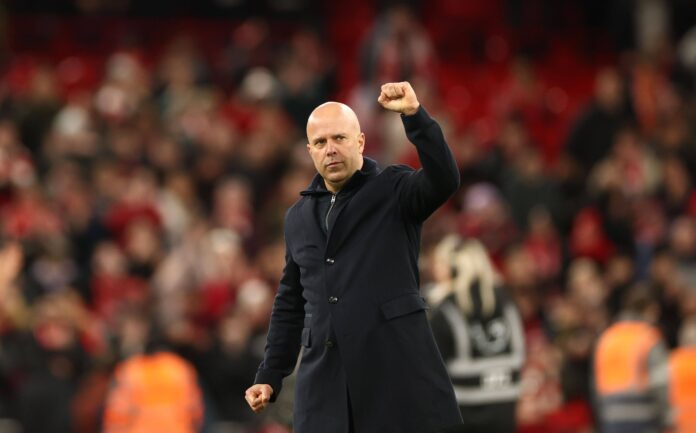

Liverpool rarely looks like a team improvising. It looks like a team choosing. The same shirt can carry different instructions from week to week, because the Premier League offers different kinds of resistance: the high press that turns every first touch into a test, the low block that asks for patience, the transition side that waits for one bad pass and then runs.
Under Arne Slot, Liverpool has leaned toward a 4-2-3-1 as a starting formation, with a double pivot that steadies the team both with and without the ball. The shape is not a cage. It is a base layer: something that lets them shift roles without losing their outline.
The “default” shape is really a set of options
A double pivot changes what Liverpool can risk. Two deeper midfielders can screen the pass into an opposition No.9, but they can also protect the moment after possession is lost, when a match can turn cruel. In tight games, that protection matters as much as any clever combination play.
The attacking midfield line in front of them is where the week-to-week variation shows. Sometimes the No.10 presses aggressively onto the opponent’s deepest midfielder. Sometimes he holds a quieter position between lines, ready to receive and turn. The same position, two different jobs, depending on who stands opposite.
Under pressure, Liverpool looks for the weak seam
A high press is a demand for speed: play now, or lose it now. Liverpool’s response is not always to fight fire with fire. It often changes the route rather than the principle. The goalkeeper and centre-backs become deliberate, drawing pressure to open a lane elsewhere.
Wide positioning is a key lever here. Slot’s attacking structure has often kept the wingers high and wide to stretch the press horizontally, forcing an opponent to choose which space to abandon. If the opposition full-back squeezes forward, the space behind him becomes a target. If the opposition stays cautious, Liverpool recycles possession and makes the press spend energy without reward.
Low blocks ask for patience
Some opponents aim to shrink the match. They defend the box, compress the centre, and accept that they will not see much of the ball. Liverpool’s most reliable answer is not constant early crossing. It is repeated access to the final third, with the ball moved until a defender steps out and leaves a seam.
Full-backs and wide rotations become essential. If the full-back holds width, the winger can drift inside and combine with the No.10. If the full-back overlaps, the winger can arrive later at the far post when markers have already turned toward the ball. In these games, the tempo is controlled, almost stubbornly, because the aim is not speed. It is the slow wearing-down of a defensive shape.
Transition teams as risk management
The most uncomfortable opponents are sometimes not the deepest, but the most direct. They sit in a compact mid-block and then attack the moment the ball turns over. Against that type of side, Liverpool often protects itself with its spacing behind the ball: the positions held to control the counter before it starts. The double pivot is central, but so is the behaviour of the full-backs. One can go, the other can stay, and the team remains balanced enough to defend the first pass forward.
This is the part of the analysis that sits close to sports betting, because results can hide the true constraint. Odds can shorten on reputation while the tactical risk grows underneath. A bettor checking prices on melbet ghana can gain an edge by asking a quiet question: Will Liverpool commit both full-backs at once, or will they stagger the risk to respect the opponent’s counter? Sports betting is often framed as prediction, but the better habit is diagnosis, because diagnosis tells you what kind of match is about to unfold.
Pressing as a set of triggers
Liverpool’s press changes shape depending on how the opponent wants to build. Against teams committed to short build-up, the press can be higher and more structured, with the No.10 stepping onto the deepest midfielder and the winger curving his run to block the easy return pass. Against teams that go long early, the press often drops a few metres and becomes a contest for second balls and loose touches.
That shift affects selection and instructions. The centre-backs and pivot players are asked to read distance: close enough to win the second ball, not so close that a flick-on becomes a clear chance. It is a small adjustment, but it changes the whole feel of a match.
The temptation to oversimplify
Tactics travel into gambling talk because they give the mind something solid to hold. Sports betting is loud in public and quiet in private, a search for structure inside a game that refuses to be tidy. Some fans drift further into casinos because the feedback feels immediate, and a cycle can be completed in minutes rather than ninety. That is why the term “aviator game” can appear in the same conversations as Liverpool’s press without sounding out of place.
The trick is to keep the categories clear. A casino game is built around short cycles and volatility; a Premier League match is built around accumulation, spacing, and the slow effect of repeated decisions. When sports betting markets are used to interpret Liverpool, focus on repeatable cues such as press triggers, full-back risk, and the spacing of the pivot rather than the last scoreline. The match does not change its nature because the odds move.
A matchday checklist for spotting the tweak
If you want to see Liverpool’s adaptation early, watch three things in the opening phase. First is the height of the wingers: are they pinning full-backs or helping build? Second is the behaviour of one full-back: overlap, invert, or hold? Third is the distance between the double pivot and the centre-backs when Liverpool loses the ball.
Liverpool’s adjustments are rarely theatrical. They are small changes in height, in angle, in how many players are allowed to leave their posts at once. Over a season, those small changes decide whether control becomes chances or danger.