

Liverpool’s season has developed an ugly habit: the match feels “managed”, the clock ticks into stoppage time… and then something breaks.
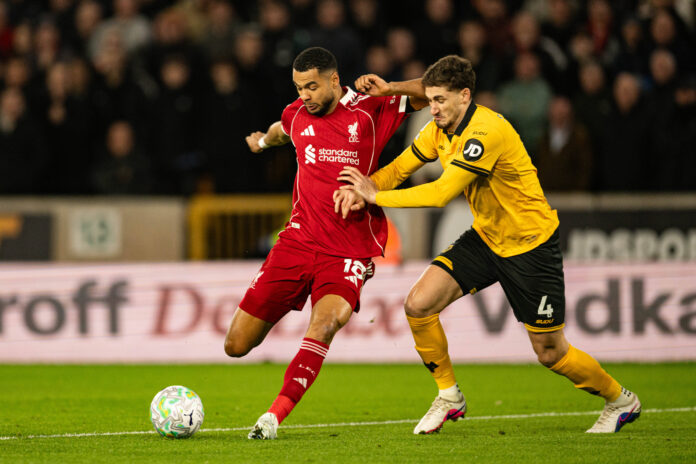
It happened again at Molineux on Tuesday. Bottom-placed Wolves scored in the 94th minute to win 2–1, handing Arne Slot another gut-punch and Liverpool another entry in an increasingly bizarre record book. Liverpool have now lost five Premier League games to 90th-minute (or later) winning goals this season — a Premier League record for a single campaign.
That headline stat is the story hook. But it’s not the full explanation — because the 2025/26 Premier League has been the league of late drama for everyone, not just Liverpool. Angliabet analysis for the Premier League has tracked a clear surge in stoppage-time and “decisive late” goals this season, and The Analyst’s data work makes the same point: more games are being altered after the 90th minute than we’ve seen before.
So this isn’t just “Liverpool are mentally weak.” It’s more interesting than that.
Think of it like two forces colliding:
- A league-wide environment that produces more late chaos (longer added time, more set-piece emphasis, more physical stoppage-time football)
- A Liverpool-specific structural problem in how Slot’s team try to control the last 10 minutes — a problem that becomes visible when legs go and decision-making speeds up.
This is the investigative question: why does Liverpool’s control keep melting late, and what can Slot change that’s tactical — not mystical?
The “late punishment” isn’t a coincidence — it’s a pattern with specific causes
Slot himself has started to speak about it like a recurring script. After Wolves, he called it the “same old story” and pointed to a familiar contradiction: Liverpool often have the ball, but struggle to turn possession into open-play goals — meaning they live close to the edge in tight games, where a single incident can flip the result.
When you combine narrow leads (or fragile draws) with a league where late goals are more common, you’ve created the perfect conditions for heartbreak: more Liverpool matches are remaining “alive” into the 90th minute, and the league is punishing that more than ever.
ESPN captured the shape of the season in one line: Liverpool are repeatedly playing games that remain knife-edge late — and the jeopardy is amplified by the absence of “game-changing substitutes” in certain moments.
That’s the macro context. Now the football.
Slot’s structure: where Liverpool want control, and where it breaks
Slot’s Liverpool are built to control games with positional structure. In possession, the modern “SlotBall” shape is often described as a dynamic version of 3-2-5 / 2-3-5: a back line of three (sometimes created by an inverted fullback or a tucked-in wide defender), two midfielders as the platform, and five players occupying the last line and half-spaces.
In Slot’s title-winning first season, this structure worked because it created two things at once:
- Stable ball circulation (enough short angles to keep the ball moving under pressure)
- Stable rest defence (enough protection behind the ball to kill counters quickly)
Analysts at Total Football Analysis and the Premier League’s own tactical write-ups of Liverpool’s title season emphasised the idea: Liverpool became less chaotic than late-Klopp without losing edge — “control with teeth.”
So why does it unravel late now?
Because the last 10 minutes of a Premier League match are not a normal football environment. They are the most unnatural phase of the game: more direct play, more set pieces, more second balls, more bodies in the box, and (this season) more time added on.
When the environment changes, the system must adapt. Liverpool haven’t adapted consistently.
The four late-game failure modes showing up again and again
1) Rest defence erosion: the distances get bigger
Rest defence isn’t “defending deep.” It’s what you leave behind the ball to protect yourself while you attack.
In Slot’s scheme, when it’s humming, Liverpool’s rest defence looks like a rehearsed safety net: three players spaced across the pitch with two screeners in front, ready to win the second ball and stop transitions early.
Late in matches, those distances stretch. A tired press arrives half a second late. A midfielder can’t quite cover the passing lane. A fullback is caught between joining the attack and protecting the channel.
At Wolves, the decisive moment didn’t come from Wolves carving Liverpool open with 20 passes. It came from scramble football: Liverpool fail to clear cleanly, Wolves keep it alive, and Liverpool don’t reset fast enough before the final shot (deflected, but still the product of disorder).
This is the rest-defence story in one line: Liverpool are not consistently “set” when the next phase begins.
2) Ball security drops: Liverpool start giving the opponent “free attacks”
The best late-game defending is often the simplest: keep the ball, slow the rhythm, choose safe progressions, and make the opponent run.
Slot’s Liverpool often do the opposite late: the circulation becomes predictable, a vertical pass is forced, possession is lost, and suddenly Liverpool are defending their box again. Slot himself has complained about the aesthetic decline of the league and the growing dominance of set-piece and direct moments — and, crucially, Liverpool have found themselves pulled into that kind of match state.
Even when Liverpool improved their set-piece output (and they have — dramatically since January, according to FourFourTwo), that doesn’t automatically fix the open-play control problem.
3) Pressing ambiguity: half-pressing is the worst option
Under Klopp, Liverpool often pressed like it was a moral duty — and when they didn’t press, they dropped into a clearly defined block. Slot’s football has more “control phases,” more patience, more positional responsibility.
The late-game problem is when Liverpool do neither: they step out without conviction, leaving gaps behind the press, and they don’t settle into a compact block that protects central zones.
That “in-between” behaviour is where late goals are born: the opponent can hit an early ball forward, win a second ball, and suddenly Liverpool are defending a situation they never wanted.
4) Substitution knock-ons: changing players changes the geometry
This is where the ESPN point about “game-changing substitutes” matters — but not in the obvious way.
Substitutions aren’t only about quality. They change the geometry of your team:
- Who offers the safe passing angle?
- Who covers the half-space?
- Who makes the recovery run?
- Who leads the line of the press?
The Times and Guardian reporting around Liverpool’s season has repeatedly pointed to injuries and availability issues (and the knock-on effect on cohesion), plus the reality that several summer additions have required adaptation time.
When Liverpool are already struggling to score from open play (Slot’s complaint), the temptation is to chase the game with attacking changes — but those changes can thin the rest defence and invite exactly the kind of late wave that has punished them five times.
“What worked before” — and what’s missing now
The most useful comparison isn’t romantic Klopp vs Slot nostalgia. It’s Slot Year 1 vs Slot Year 2.
Year 1 (the title season), Liverpool’s structure was new and opponents were still learning how to disrupt it. The Premier League’s own analysis of that title run emphasised “tactical tweaks” and the stability of Liverpool’s patterns.
Year 2, opponents have a map.
Several tactical outlets have framed the same idea: you can beat Slot’s Liverpool by forcing them into the wrong kind of game — crowding central build-up lanes, pushing them wide, then attacking the moment possession is lost (especially late).
And on top of opponent adaptation, there’s a huge contextual change: the league itself has become more stoppage-time heavy than it was last season. So even if Liverpool were unchanged, they’d still be exposed to more late volatility than in 2024/25.
Star players: why this isn’t only “system” — it’s roles and moments
A system fails through people. That’s not blame — it’s football.
After Wolves, Virgil van Dijk described Liverpool’s performance as “slow, predictable and sloppy,” and those words matter because they’re not just emotional. They describe the two late-game killers:
- Slow: you can’t reset your rest defence
- Predictable: you can’t keep the ball under pressure
- Sloppy: you create the opponent’s best moments for free
Mohamed Salah remains Liverpool’s match-decider — and he did score at Wolves — but in tight games Liverpool have increasingly needed moments rather than sustained chance creation, which keeps matches alive late.
At the back, the issue is not “Liverpool can’t defend.” It’s Liverpool’s defending when structure is broken — the moments after the first duel, the half-clearance, the deflection, the failure to step and squeeze together. Wolves’ late winner was born in that exact chaos.
How Slot can fix it: four tactical “endgame” rules Liverpool need immediately
Fixes have to be practical. Not vibes. Not “want it more.” Here are four changes that address the actual mechanisms of late concessions.
Fix 1: Install a late-game rest-defence protocol (no improvisation)
When Liverpool are leading or drawing after 80 minutes, the team should default into a protection-first attacking structure:
- Maintain a clear 3+2 behind the ball
- Do not allow both fullbacks to be high at once
- Keep one midfielder “anchored” rather than hunting the next pass
If Slot wants to remain philosophically committed to possession, fine — but the shape must be engineered to survive turnovers in the last 10.
Fix 2: Reduce “hero passes” late — increase third-man safety
Late on, Liverpool need one obsession: don’t give the opponent free transitions.
That means:
- more third-man combinations (bounce passes)
- fewer forced vertical balls through traffic
- clearer wide outlets to reset play
This is where Slot’s “control” identity should be strongest — and right now it’s where it disappears.
Fix 3: Choose one defensive mode after 80 minutes
Liverpool currently drift between:
- an aggressive press that isn’t quite timed
- and a passive block that isn’t quite compact
Pick one based on game state and personnel. A half-press is an invitation.
Fix 4: Substitutions must protect zones, not just add legs
Slot needs a substitution template that answers:
- Who protects the half-spaces?
- Who wins second balls?
- Who slows the game with the ball?
If Liverpool’s problem is late chaos, the solution is not always “fresh attackers.” Sometimes the most valuable sub is the player who turns a frantic match into a boring one.
The uncomfortable conclusion: Liverpool are being punished by the season they’re living in
Liverpool’s record of five stoppage-time defeats is shocking — but it’s also happening in the noisiest stoppage-time season in Premier League history.
That doesn’t absolve them. It clarifies the task.
Slot can’t coach the league into adding less time or caring less about set pieces. But he can coach Liverpool into a better endgame:
- tighter rest defence
- calmer ball circulation
- clearer pressing decisions
- smarter substitutions
Because right now, Liverpool’s late-game issue isn’t simply that they “concede late.”
It’s that they keep creating the conditions where conceding late is the most likely outcome — and in 2025/26, the Premier League is punishing that harder than ever.