
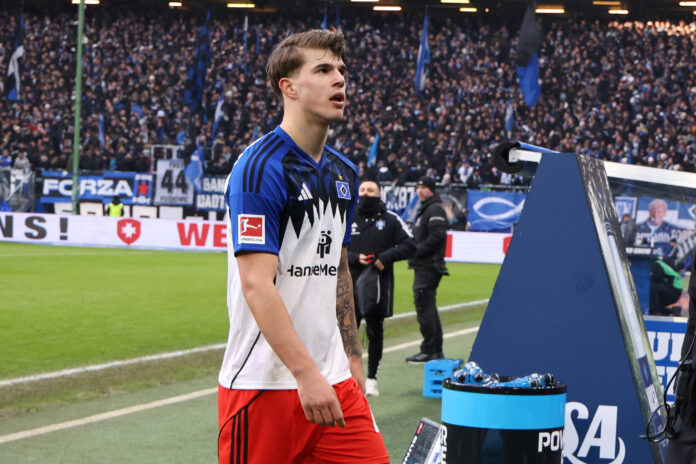

Vuskovic to Liverpool: Data, Doubt and Defensive Promise
Liverpool’s transfer strategy is beginning to take shape ahead of a pivotal summer, with centre-back recruitment once again under scrutiny. Among the emerging names is Vuskovic, a young defender attracting attention across Europe. As revealed in a recent Anfield Index discussion, Liverpool are actively monitoring the player, alongside several elite clubs, suggesting this is more than idle scouting noise.
The question, however, is not whether Vuskovic has talent. It is whether he fits Liverpool.
Profile of Vuskovic: Strengths That Stand Out
There is no ambiguity when analysing Vuskovic’s defensive output. His aerial dominance is exceptional, bordering on elite for a player of his age. As Dr Phil Barter explains, “his aerial is 96 percentile… threat prevented… 98th percentile, which is actually incredible considering who he plays for.” That alone places him in rarefied territory among young centre-backs.
Physically imposing and comfortable in deep defensive structures, Vuskovic thrives as what Barter calls “an air marshal… a box protector.” His clearance rate, sitting in the 94th percentile, reinforces that identity. He is a defender built to repel, not to orchestrate.
There is also a notable attacking threat from set-pieces. “He’s good in both boxes… 98 percentile for goals,” Barter notes, highlighting his ability to convert aerial situations into tangible output.
In isolation, these are traits Liverpool have historically valued. Dominance in the air, presence in the box, and reliability under pressure all align with traditional Premier League demands.
Concerns Around Ball Progression and Pace
Yet modern Liverpool require more than defensive solidity. The system demands defenders who initiate attacks, step into midfield, and play through pressure. This is where concerns begin to surface.
Barter is unequivocal: “On the ball… it’s a very limited picture.” With passing accuracy in the 27th percentile, Vuskovic falls well below the technical baseline expected at Anfield. Even his progressive metrics remain modest, suggesting a reluctance or inability to advance play effectively.
Pace is another critical issue. In a league defined by transitional speed, marginal deficits become glaring weaknesses. As highlighted in the original discussion, Vuskovic’s recorded top speed of 31.16 km/h raises red flags when compared to elite forwards who regularly exceed 35 km/h.
That gap matters. Liverpool defend large spaces. A centre-back lacking recovery speed risks being exposed repeatedly.
Tactical Fit at Liverpool: System Compatibility Questions
Liverpool’s defensive structure is not passive. It requires mobility, anticipation, and positional intelligence in wide channels. Vuskovic, by contrast, appears more suited to a low-block system.
Barter offers a crucial insight: “If they’re going to play a lower block… the ability to intercept passes is limited.” His interception numbers, sitting in the 38th percentile, reflect that environment rather than proactive defending.
There is also the issue of tackling style. “He does have a tendency to go to ground… in the box,” Barter warns. In the Premier League, such tendencies can quickly become liabilities.
For Vuskovic to function effectively at Liverpool, structural adjustments would be required. As noted in the analysis, “the only way this makes total sense… is if you’re bringing in an incredibly mobile six” to compensate for his limitations.
Without that support, the risk profile increases significantly.
Transfer Value Debate and Long-Term Projection
Valuation is where the discussion becomes even sharper. Current estimates place Vuskovic at around €60 million, roughly £50 million. For a developing defender with clear technical limitations, that figure invites scrutiny.
Barter is blunt: “If you said to me 30 million euros… I can see how that works. But 50 for that player… I would have serious question marks.”
Liverpool are not in the business of speculative spending at that level. Recruitment is typically aligned with both system fit and long-term scalability. While Vuskovic offers raw defensive traits, his development curve may not align with immediate first-team demands.
There is also a broader squad context. With existing options and younger prospects already in the pipeline, adding another developmental centre-back at a premium price feels strategically inconsistent.
Conclusion: Intriguing Talent, Imperfect Match
Vuskovic is, without doubt, an intriguing defensive prospect. His aerial dominance, physical presence, and box defending mark him out as a specialist with clear strengths.
However, Liverpool require completeness. Ball progression, pace, and tactical adaptability are non-negotiable in their current system. On those metrics, Vuskovic remains a work in progress.
As Dr Phil Barter succinctly frames it, “he does seem to love defending… but does he completely fit into our style of play? Probably not. Not long term anyway.”
Liverpool’s interest is understandable. Their caution should be equally so.