





Combined XI Verdict: Liverpool and Man Utd Through a Statistical Lens
Data-first selection reshapes combined XI debate
The idea of a combined XI between Liverpool and Man Utd is often driven by reputation, legacy and tribal bias. Strip all of that away and what remains is something far more revealing. This particular selection leans entirely on current-season output, role-specific metrics and measurable contribution. It is a team built not on sentiment but on evidence.
In this context, the combined XI becomes less about who you recognise and more about who is actually delivering. It is a subtle but significant shift, and one that immediately alters the balance of the Liverpool and Man Utd debate.
Defensive structure grounded in consistency
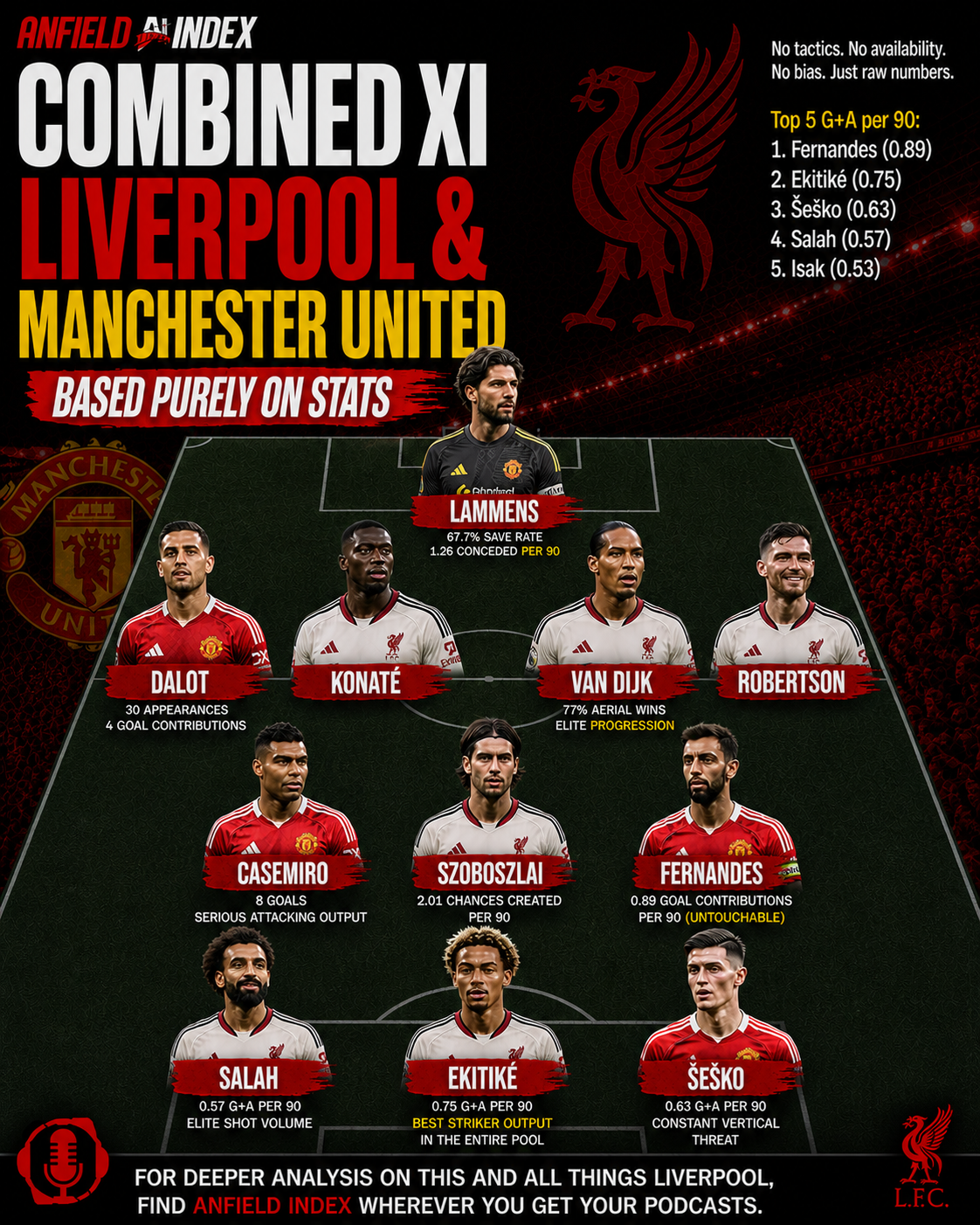
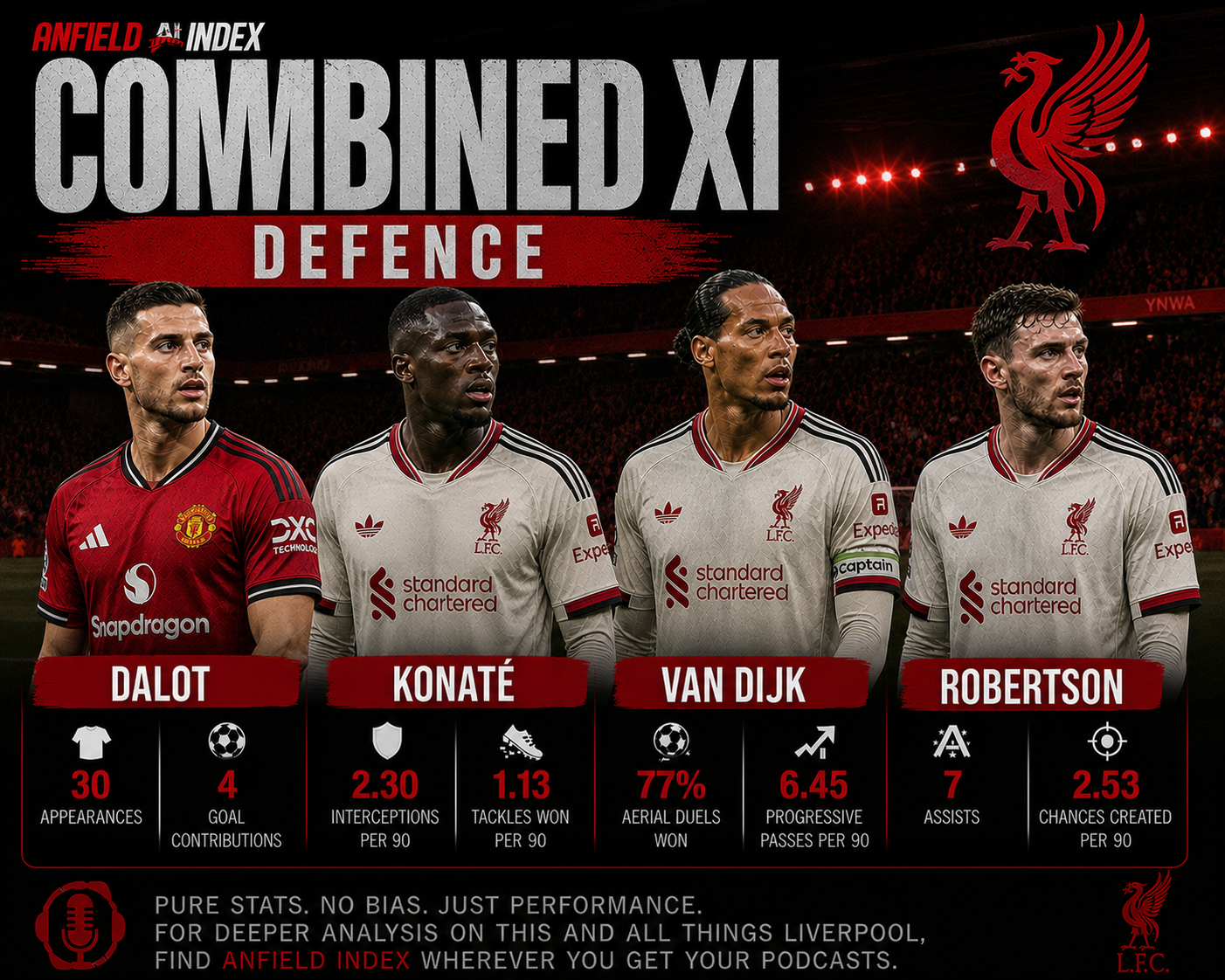
At the back, the data paints a picture of reliability and control. Virgil van Dijk remains the standout figure, his 77.3 per cent aerial duel success and 50.5 per cent long-pass accuracy offering both defensive authority and progression from deep. Alongside him, Ibrahima Konaté provides recovery pace and positional discipline, forming a pairing that is as functional as it is formidable.
The full-back positions are equally pragmatic. Diogo Dalot’s selection is driven by durability and contribution across both phases, with over 2,200 minutes played and a steady attacking return. On the opposite flank, Andrew Robertson retains his place as a natural left-sided outlet, offering width and overlap rather than inversion.
Even in goal, the numbers dictate the outcome. Senne Lammens is selected on the strength of a 67.7 per cent save rate and a goals-against figure of 1.26 per 90. It is not glamorous, but it is consistent, and that matters in a data-led framework.
Midfield dominance driven by creativity and output
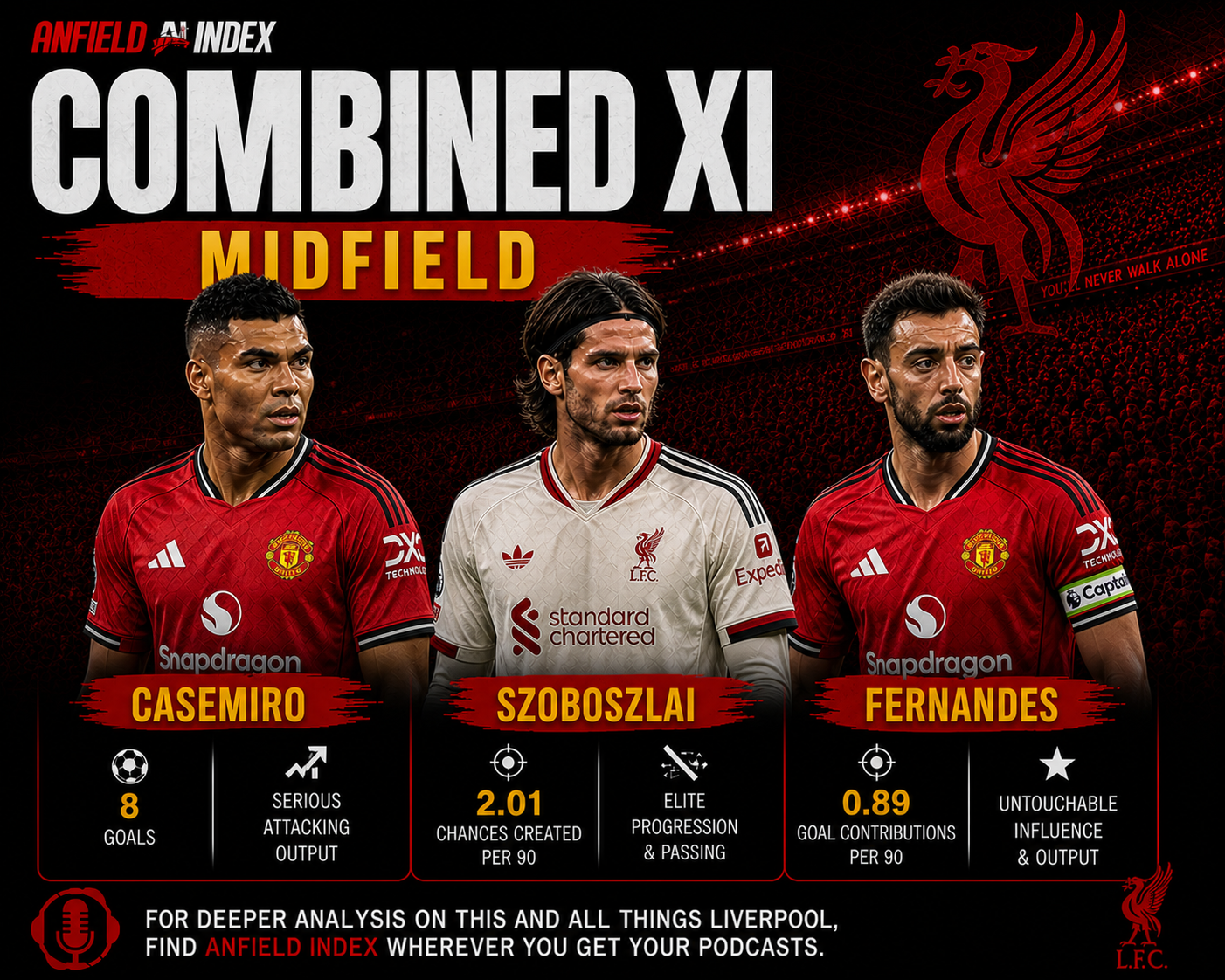
If defence is about stability, midfield is where this combined XI truly comes alive. Bruno Fernandes stands as the defining figure, his statistical profile overwhelming. The original analysis describes him as “the dominant creator in the current data set”, supported by 19 assists, 114 chances created and a league-leading expected assists figure of 10.3.
Around him, the balance is carefully constructed. Ryan Gravenberch offers control from deeper areas, contributing both mobility and a respectable return of four goals and three assists. Dominik Szoboszlai earns his place through sheer creative volume, averaging 2.01 chances created per 90 and delivering double-digit matches with three or more chances crafted.
This is not a midfield assembled for aesthetic appeal. It is built to produce, to sustain pressure and to feed a forward line designed for movement and efficiency.
Forward line shaped by movement and efficiency
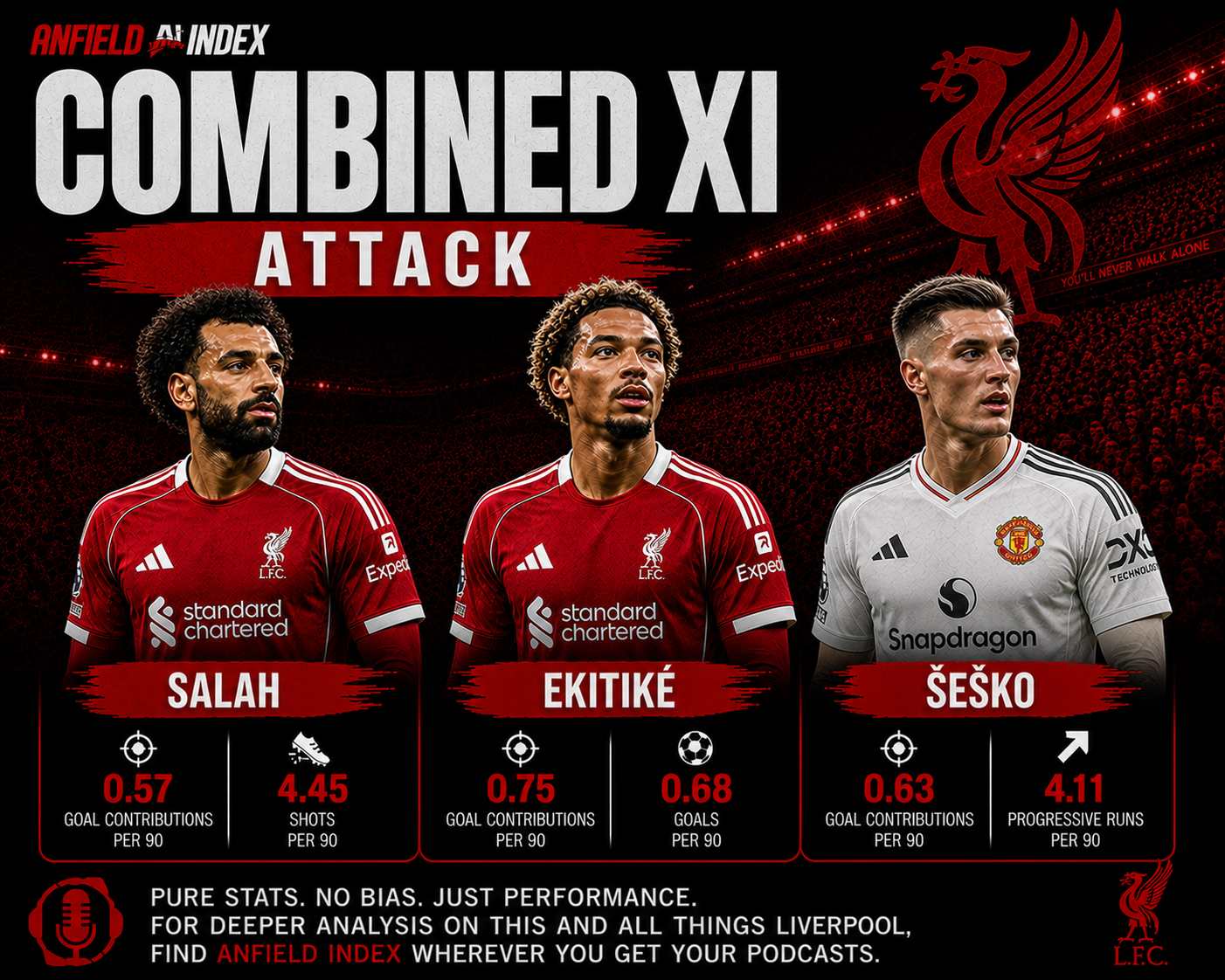
Up front, the selection reflects a clear understanding of how modern attacking play functions. Bryan Mbeumo and Benjamin Šeško are included not simply for their output but for their off-ball intelligence. Both rank among the league’s most active runners in behind, with figures of 14.8 and 11.3 runs per 90 respectively.
Florian Wirtz completes the trio, offering a secondary creative hub from the left. His 2.24 chances created per 90 and recent improvement in expected assist quality underline his growing influence. As the source material highlights, he “brings the second playmaking hub this XI needs”.
Notably, high-profile names miss out. Mohamed Salah and Hugo Ekitiké both boast elite numbers, with 0.57 and 0.75 goal contributions per 90 respectively. However, availability plays a decisive role. As stated in the original analysis, they are “treated as unavailable for selection rather than ignored”. It is a reminder that even in a numbers-driven exercise, context still matters.
Balance between output and tactical coherence
What emerges from this combined XI is a side that feels coherent rather than forced. It is not simply a collection of the biggest names from Liverpool and Man Utd. It is a system shaped by complementary profiles and measurable contribution.
In possession, the structure allows for width, verticality and layered creativity. Out of possession, it retains discipline and coverage. That balance is no accident. It is the product of a methodology that values fit alongside output, ensuring the team functions as a unit.
Ultimately, this exercise highlights a broader truth. Statistics do not tell the whole story, but they reveal enough to challenge assumptions. When applied with clarity and purpose, they offer a different lens through which to view the game.
And in the case of this combined XI, that lens produces a side that is less sentimental, more ruthless and arguably closer to what would win matches today.