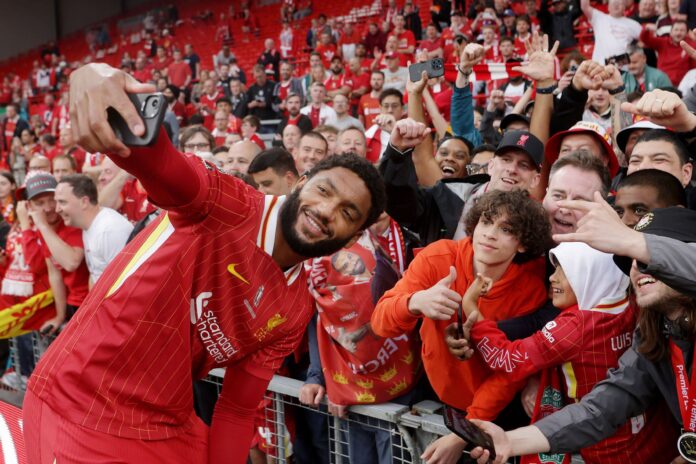

Liverpool remains one of the world’s biggest and best supported football clubs. If we take social media engagement as an indicator of popularity, official LFC social media channels had 11.9 billion annual views and 1.5 billion engagements in 2023/24, with 186 million followers worldwide.
But what makes the club stand out is not simply the size of its fanbase. Instead, it is the reputation for passionate loyalty that has inspired fans across the globe, far beyond the club’s proud local roots.
Loyalty underpins sporting success, with fan engagement an increasingly important way for modern clubs to generate revenue. Yet where many other big clubs can appear as mere cash cows, Liverpool remains a standout example of building support whilst retaining a strong emotional connection to the club’s traditions.
Unlike other clubs whose culture comes to be defined by the footballing style of individual managers, think Wenger’s Arsenal and Ferguson’s United, Liverpool has managed to retain a consistent identity throughout the generations.
As a lifelong Red, I want to explore what it is that makes Liverpool unique in a way that continues to draw modern fans, even if fandom is changing with each generation.
THE ROLE OF HISTORY AND TRADITION
The roots of Liverpool’s modern identity come back to the tenure of one man: Bill Shankly. Shankly understood the power and intense pride of the football fans in Liverpool like no other. It was Shankly who talked of the “Holy Trinity” of players, manager, and supporters as the key to club success.
The idea that Liverpool’s fanbase were active participants, and not mere spectators, became deeply embedded in the match going culture. The fans made themselves renowned throughout the 1960’s for their noise and humour, the size of their travelling support, and the introduction of spontaneous terrace singing to English stadiums.
It was also in this period that the club picked up You’ll Never Walk Alone as its iconic anthem. This culture continued to strengthen and gain admirers throughout the unprecedented period of success that followed in the 1970’s and 80’s, with Liverpool’s dominance of Europe also bringing in an international fanbase.
But where these highs have been integral to the club’s history, so too have the devastating lows. The Hillsborough disaster and the long and bitter campaign for justice that followed saw out a decade in which the city of Liverpool had already found itself at an economic low ebb.
Maligned and denigrated by much of the country, the club’s identity came to reflect this defiance against adversity and outsider status, despite the on-pitch success.
WHY ANFIELD REMAINS CENTRAL TO THE CLUB’S IDENTITY
As the club moved into the Premier League era its dominance faded. Television soon dwarfed match attendance as the most common way to watch football and people around the world began tuning in in large numbers.
Yet, despite a thirty-year title drought, Liverpool continued to draw in fans. But why? It is here that Anfield cemented its crucial role as central to the club’s identity.
Anfield is perhaps the most mythologised stadium in world football. It has been known for vociferous support since before even Shankly. Yet, in an era of commercialisation and new forms of fandom, it is Anfield that has allowed Liverpool fans to continue to express their communal passion and support.
This is true of other stadiums, of course. But where Anfield differs is the strength of its reputation as a place that can turn the tide in crucial games, and that even the biggest teams fear to tread. Anfield has come to represent the physical embodiment of Liverpool’s supporter culture.
The 2004/05 Champions League campaign illustrated this perfectly. It was here that the fame of Liverpool’s match-going fans was cemented among a truly global audience. The singing of You’ll Never Walk Alone at halftime while 3-0 down in the final typified the never-say-die attitude and unwavering loyalty of the fanbase.
Up until 2005, Liverpool had largely been trading in on past glories. But all of a sudden, the strength of Liverpool’s support on the biggest stage was beamed worldwide and helped bring in a whole new generation of fans.
THE IMPACT OF THE KLOPP ERA ON GLOBAL ENGAGEMENT
If the 2005 Champions League helped the club stay relevant amid Manchester United dominance. By the 2010’s and his arrival, it was starting to feel like a Premier League title may never come. Without further success, Liverpool could easily have fallen behind as the social media era kicked in and other clubs took the lead. Enter Jurgen Klopp.
Klopp was easily Liverpool’s most charismatic manager since Shankly. And like Shankly, he understood perfectly the importance of the fans and power of Anfield in driving team performances.
The German introduced exciting, hard pressing, and fast-paced football that would get the fans off their feet from the first whistle to the last. This approach soon began to work wonders, ending the title drought and bagging another Champions League trophy.
Liverpool’s dramatic comeback against Barcelona – one of Anfields greatest ever nights – was the perfect culmination of everything that Liverpool’s self-image is all about. Klopp had successfully revived the Holy Trinity for a new era of global football fandom.
HOW YOUNGER FANS ARE DISCOVERING LIVERPOOL TODAY
The riveting Klopp years and renewed success were captured perfectly by the club’s slick PR operation. Liverpool have been at the forefront of social media engagement over the last ten years, promoting the history, traditions, and reputation of Liverpool to a younger online fanbase.
Klopp soundbites, player engagement and matchday content have been viewed by millions. As the Premier League market has further expanded into new countries and continents, Liverpool has been perfectly placed to take advantage and win over new fans.
WHY COMMUNITY REMAINS A KEY PART OF THE CLUB’S APPEAL
In todays fractured world many people are in search of a sense of connection. It is here that Liverpool’s strong communal ethos continues to provide meaning to people across the world.
For many fans, You’ll Never Walk Alone is far more than an anthem or a motto. Whenever you bump into a fellow Red in the street, watch the match in a bar, engage online, or make the pilgrimage to Anfield, you feel you share a connection that is more than just football.