






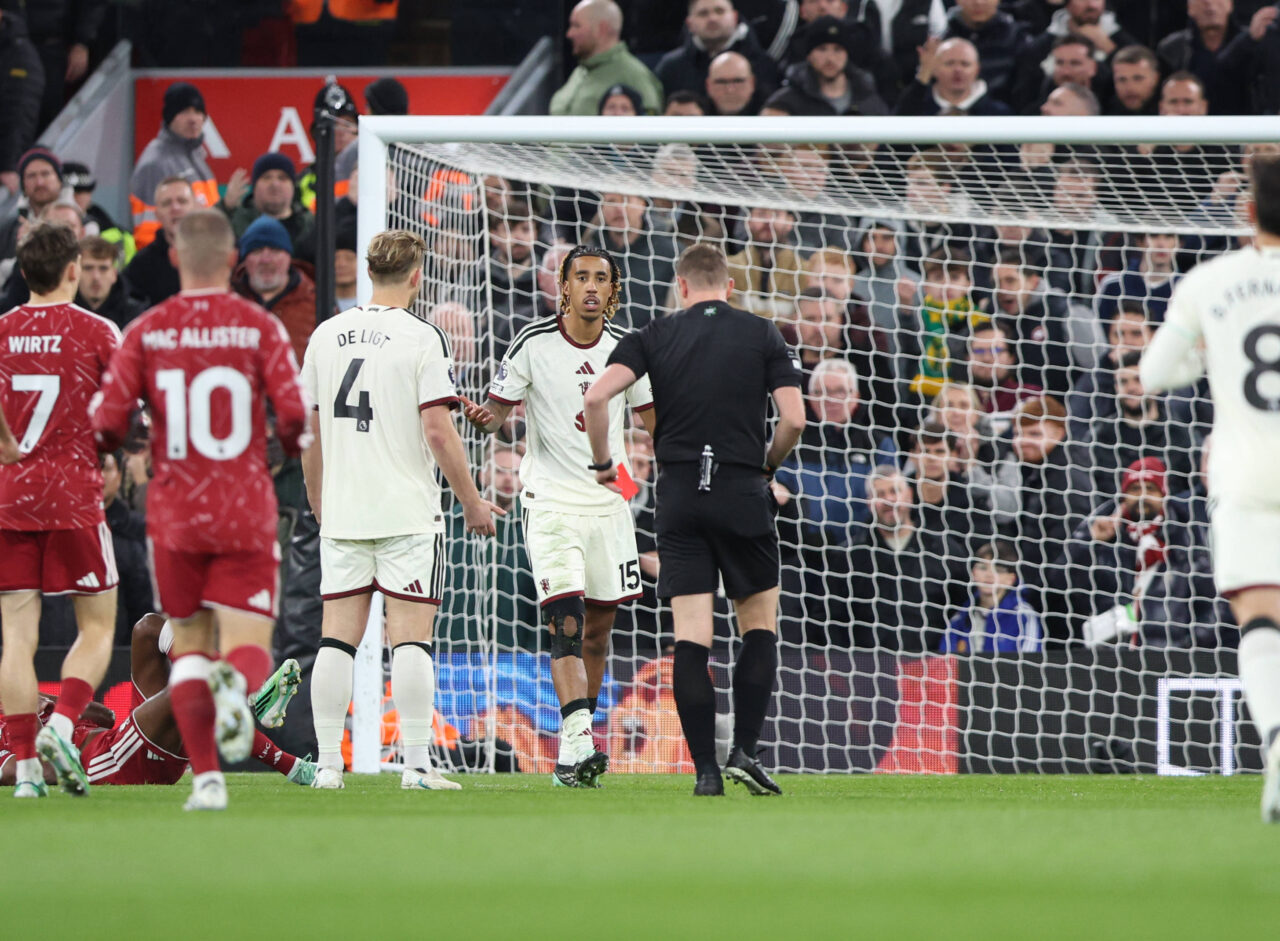
Leny Yoro Red Card Overturned After Liverpool Defeat as Howard Webb Stands by Anfield Decision
Manchester United have won their appeal against Leny Yoro’s early dismissal at Anfield, meaning the defender is now free to play against Brentford. The decision removes the immediate sporting consequence for Mauricio Pochettino’s side, but it has not brought full agreement on the incident itself.
Yoro was sent off inside the opening eight minutes of United’s 4-0 defeat to Liverpool after colliding with Alexander Isak as the forward broke through on goal. The dismissal proved a major turning point in a one-sided contest, with Liverpool taking full control and United unable to recover after going down to 10 men.
While the Football Association has now rescinded the red card, Howard Webb has made clear that the original on-field decision remains defensible in his view. That leaves an unusual split, with the suspension lifted but the refereeing chief still publicly backing the judgment made during the game.

Appeal Success Offers United a Boost
United’s appeal has at least ensured Yoro avoids a ban at a time when availability matters. Pochettino had reacted angrily in the aftermath of the match, arguing the challenge did not warrant a dismissal and pointing to perceived inconsistency in similar situations elsewhere.
For United, that appeal outcome is important ahead of a demanding run of fixtures, starting with Brentford in the league and followed by a Champions League meeting with Sporting CP. It also spares Yoro, one of the club’s key young defenders, from further disruption after a difficult afternoon at Anfield.
The broader debate, however, has centred on whether the challenge denied an obvious goalscoring opportunity. That is where Webb’s explanation becomes significant, because he believes the referee had sufficient grounds to reach for a red card even if others interpreted the sequence differently.
Howard Webb Explains Why Decision Stood
Speaking publicly about the moment, Webb said, “Firstly, I want to say, I think this is a really decisive decision by the referee, Sam Barrott. We know it’s clearly a foul. I don’t think there’s any dispute about that.”
He then set out the framework officials use in such cases, adding, “And we also know that it’s outside the penalty area. we’re thinking about the sanction, aren’t we, that’s why we’re talking about this.”
Webb’s breakdown focused on the standard criteria for denying an obvious goalscoring opportunity, including direction of play, distance from goal, covering defenders and whether the attacker would likely retain control of the ball. On those points, he said, “Is it a denial of an obvious goal scoring opportunity? Four considerations officials have to think about. direction of play, it’s definitely going towards the goal. It’s not going out wide. Proximity from goal, well, it’s just outside the penalty area. the location of other defenders. Well, there’s only Yoro there. The keeper is moving back towards his own goal.”
Isak Control Debate Remains Central
The key element was always whether Isak would have reached the ball ahead of goalkeeper Senne Lammens. Webb addressed that directly, saying, “He has to put the brakes on and possibly come back out. the reason we’re talking about it is the fourth consideration, that’s control or likelihood of keeping on or gaining control of the ball. Isak’s got control of the ball, he’s got possession, he’s got the touch, he knocks it past Yoro.”
He continued, “He’s moving at pace at that moment, and a foul comes in and knocks him down.”
That sequence explains why the video assistant referee did not intervene. In Webb’s view, there was not enough certainty to class the on-field red card as a clear and obvious error. He said, “And there’s a question mark, I guess, around whether or not he would get onto that ball before Senne Lammens. Now, in the moment, the referee looked at it and felt he would. That was the referee’s call made on the field, and then the VAR checks that to see whether that decision made on the field was clearly and obviously incorrect, and formed the opinion that it wasn’t, that if there was any doubt, then it was doubt.”
United Move On as Debate Continues
Webb concluded by underlining why the officials stayed with the dismissal, stating, “It wasn’t going to be something that was clearly and obviously wrong and therefore allowed that decisive on-field decision to stand. and i think by and large, most people would see that as a correct decision, with Isak moving quickly on towards that ball.” He added, “The alternative view is that Lammens might get there first, but I think it’s a little bit debatable, I guess. Certainly not clearly wrong.”
So, the red card has gone, Yoro is available again, and United can focus on what comes next. Yet the episode will continue to feed discussion around VAR, referee discretion and the threshold for overturning major calls in high-profile matches.