


Curtis Jones role in midfield balance
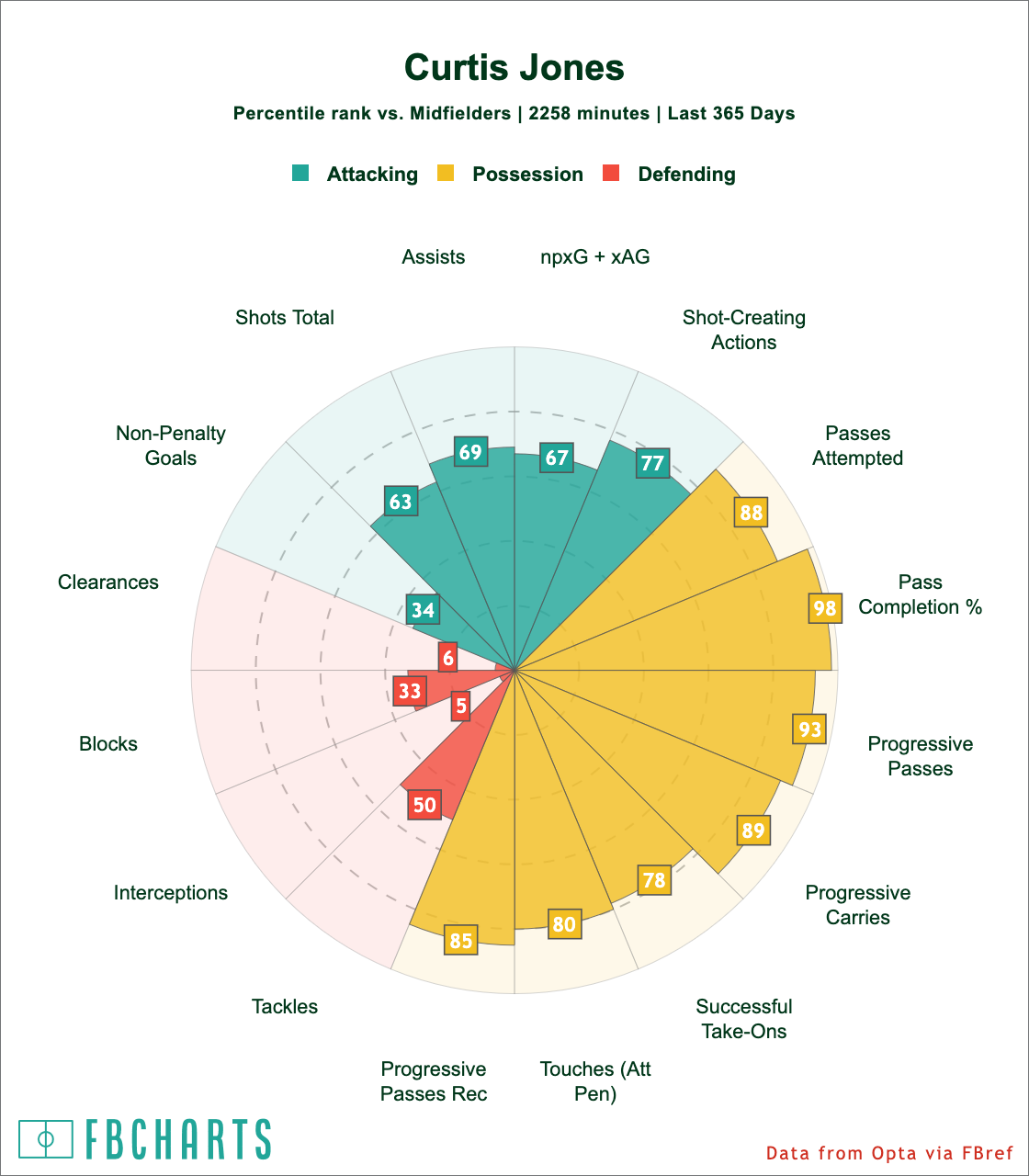
Curtis Jones’ performance against Brighton was rooted in balance. He offered defensive diligence without sacrificing composure in possession, allowing Liverpool to function smoothly through the central areas. Brighton’s midfield rotation can unsettle opponents, but Jones repeatedly read danger early, stepping into passing lanes and disrupting rhythm before it developed.
Operating within a midfield three, Jones showed discipline in holding his position when required and intelligence in pressing when Brighton attempted to play through the lines. His passing was measured rather than showy, yet consistently progressive. Liverpool looked calmer when Jones was involved in transitions, particularly during Brighton’s strongest spells in the second half.
This was not a performance built on highlight moments but on sustained efficiency. Jones ensured Liverpool were rarely exposed centrally, helping Slot’s side maintain compact distances between defence and midfield. That control proved decisive in protecting the clean sheet.
Danny Murphy assessment of standout performer
Danny Murphy’s post-match comments reflected what many observed during the ninety minutes. While praising Ekitike’s confidence and end product, Murphy repeatedly returned to Jones when identifying Liverpool’s most influential figure.
Murphy noted Jones’ ability to “set the tone without the ball and be great with it”, a description that captured the essence of his display. It was the kind of performance that often escapes statistical headlines but resonates deeply with former midfielders who understand the demands of controlling space and tempo.
Murphy also contextualised Jones’ importance across multiple matches, not just this win. In recent weeks, Liverpool’s midfield has undergone adjustments due to injuries and tactical tweaks. Jones has emerged as a constant, providing reliability regardless of shape or opponent.
Arne Slot system adjustment explained
Slot’s decision to revert to a 4-3-2-1 formation suited both the opponent and his personnel. Brighton’s insistence on building through midfield offered Liverpool opportunities to press intelligently rather than chase aggressively. Jones thrived in that environment, where decision-making outweighed physical dominance.
Slot later acknowledged that Liverpool required both hard work and a measure of fortune to secure the win. He highlighted the team’s defensive cohesion, particularly when Brighton forced Liverpool into deeper areas. That compactness was built from midfield discipline, with Jones central to maintaining structure when Liverpool were under pressure.
The Dutch coach also referenced recent adversity, including injuries and demanding fixtures. Against that backdrop, performances rooted in mentality and organisation carried added significance.
Brighton victory reflects growing control
Ekitike’s early goal set the tone, and his second-half header ultimately sealed the result, but Liverpool’s control between those moments told a more revealing story. Brighton created chances, yet Liverpool rarely looked chaotic. Jones’ influence ensured that defensive phases were structured rather than reactive.
Moving up to sixth in the Premier League matters, but the performance suggested something more sustainable than a single result. Liverpool looked like a side learning how to manage games, not merely chase them.
For Jones, this was another step in a season where responsibility has increasingly replaced promise. Under Slot, he appears trusted to interpret space, regulate tempo and execute tactical instruction with maturity.
Murphy’s verdict was telling because it aligned so clearly with the tactical reality. Curtis Jones did not dominate through spectacle, but through control. In matches like this, that distinction often decides outcomes.