


Kees Smit omission risks becoming a Liverpool mistake in midfield planning
Midfield demands rising under Slot
Liverpool’s midfield has become the engine room of Arne Slot’s approach, but recent selection patterns have also highlighted how tight the margins are becoming. Against Brighton, Slot named Florian Wirtz, Dominik Szoboszlai, Alexis Mac Allister, Ryan Gravenberch and Curtis Jones in the starting XI, with Wataru Endo unavailable through injury. The wider tactical wrinkle was the lack of a conventional winger profile in the front line, which increased the workload on central areas to provide width, control and final-third invention.
That matters when assessing recruitment. Slot’s model leans on midfielders who can cover multiple roles without a drop in intensity: players comfortable receiving under pressure, switching play quickly and arriving late into scoring zones. Over a season, that type of demand rarely stays contained to a preferred first-choice group. Injuries, fatigue and form swings are inevitable, and when they hit, depth is not a luxury but a requirement.
Liverpool’s issue is not talent at the top end. It is what happens behind it when rotation becomes necessary and the bench does not offer like-for-like solutions. That is where the conversation around Kees Smit becomes relevant, quickly.
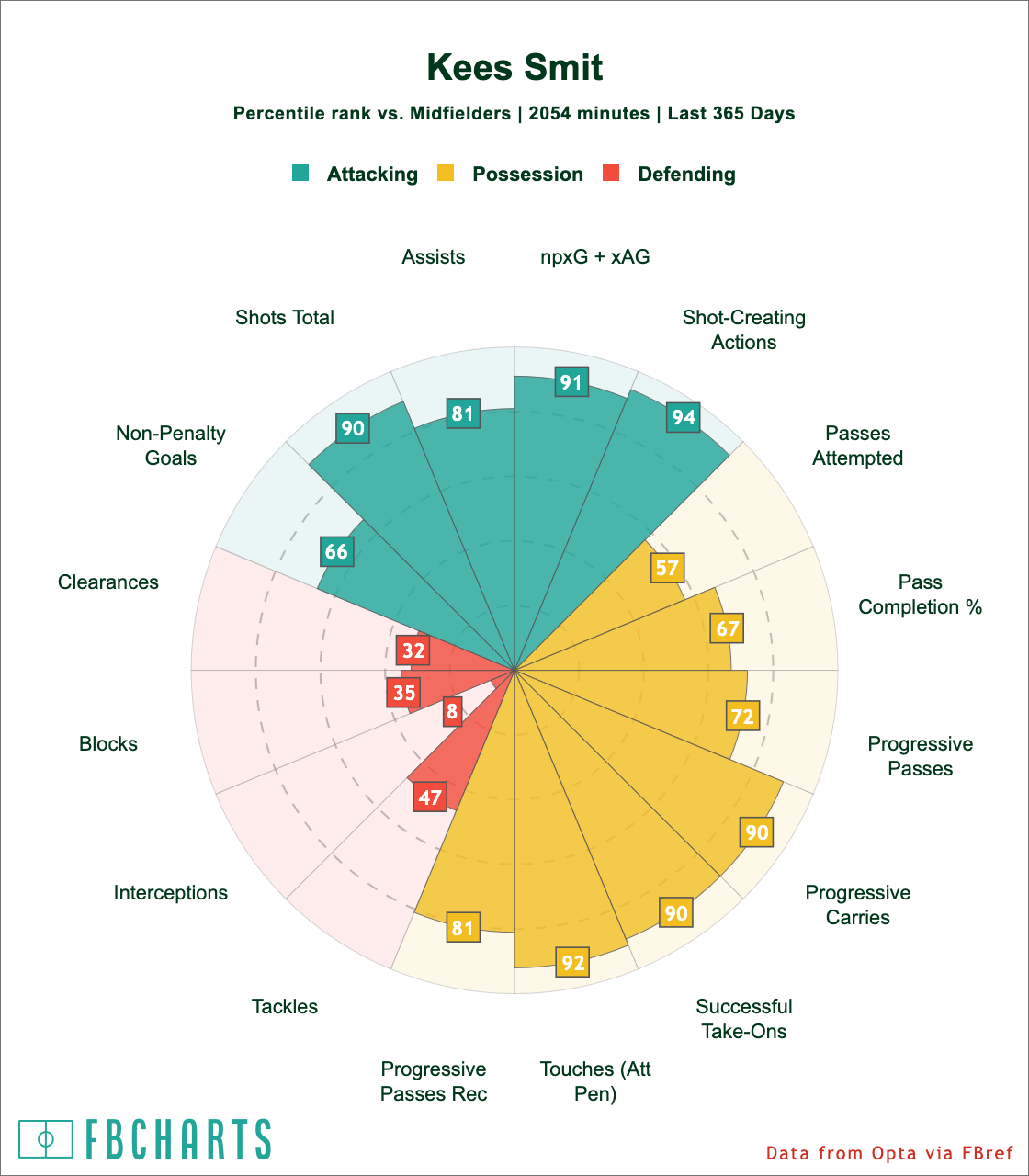
Kees Smit profile fits multi-role requirement
Smit, the 19-year-old AZ Alkmaar midfielder, has emerged as one of the most complete young options in the market, precisely because his game is not restricted to one lane. He has logged heavy minutes across the campaign, already pushing the sort of workload normally associated with established senior starters, and he has continued to deliver output too, with five goal contributions.
What stands out is how he moves across midfield zones. He can drop into deeper positions to help build play, operate as a No. 8 in central traffic, and then appear higher up the pitch as a false No. 10 when the game opens. That spread is not just a heat map curiosity; it is an indicator of tactical reliability. Coaches play young midfielders that much only when they trust their decision-making.
International recognition has also raised his profile. Ronald Koeman has compared him stylistically to Pedri, which is a lofty reference point but one rooted in similar traits: press resistance, clever angles of receiving, and an ability to connect phases rather than simply participate in them.
At a reported valuation around £25m according to Anfield Watch, potentially rising closer to £30m depending on bidding dynamics, Smit sits in the bracket where elite clubs can act decisively without treating it as a headline, budget-shifting commitment.
Rival interest intensifies as Liverpool name goes quiet
The most recent noise has pointed away from Anfield. Reporting suggests Chelsea are currently positioned as frontrunners, with Newcastle, Tottenham and Manchester United also monitoring the situation. The notable detail is Liverpool’s omission from that cluster, particularly because earlier coverage elsewhere had painted a different picture.
Transfer information is rarely clean and sources differ. Yet the reality of a January market is that momentum can become the story. When several Premier League clubs move in the same direction, the club that hesitates often ends up paying more later, either for the same player or for an alternative with fewer boxes ticked.
If Liverpool are genuinely not active in this one, it becomes fair to ask why. A player with Smit’s age, versatility and minutes base fits the type of proactive recruitment Liverpool have typically valued: buy before the peak, integrate carefully, then benefit when the player becomes a core option.
Mistake argument centres on depth, not hype
This is not about signing a name for the sake of it. The mistake risk is structural. Liverpool’s midfield has been asked to do a lot, and in the Brighton match the squad depth issue was difficult to ignore. Slot effectively used almost every senior midfield option available to him, leaving little flexibility if the game state demanded a different profile.
Smit would not need to arrive as a guaranteed starter to be valuable. His appeal is that he can cover roles across the unit, reducing the need to reshape the entire system when one piece is missing. That is exactly how top squads protect themselves across a long season.
There is also a practical integration argument. Liverpool already have a strong Dutch connection within the squad and staff, which can help bedding-in time, cultural comfort and tactical translation. In marginal decisions, those details matter.
If Smit ends up joining a direct Premier League rival, the consequences could be two-fold: Liverpool miss a stylistic fit for Slot’s midfield demands, and they watch an opponent strengthen in a position Liverpool themselves are likely to address sooner rather than later. That is how a quiet decision in December becomes an obvious mistake by spring.