
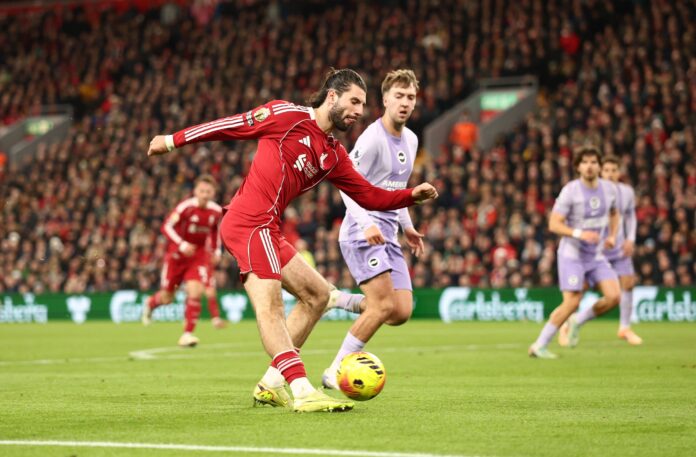

Liverpool 0 – 0 Leeds – Premier League Man of the Match
Dominik Szoboszlai
The Only Player Trying to Break the Pattern
There was a familiarity to this game that made it all the more depressing. A disciplined, well-organised visiting side arrived at Anfield with a clear plan: stifle, slow, frustrate, and wait. Liverpool, despite enjoying territory and possession, once again lacked imagination, incision, and conviction. It was another afternoon where control existed in theory but not in substance, and where the crowd spent more time urging urgency than celebrating quality.
In that fog of inertia, Dominik Szoboszlai stood out simply because he refused to accept the pace and tone of the contest. While others recycled possession sideways or took the safe option, the Hungarian captain kept demanding the ball, kept driving into space, and kept trying to inject life into a game that desperately needed it. His versatility saw him move across zones, asked to fill gaps, cover full-backs, and arrive late into attacking areas. None of it was glamorous, but all of it was necessary.
What separated Szoboszlai from the rest was not brilliance, but intent. He played like a footballer who understood the stakes, who sensed that another home draw against a promoted side was unacceptable, and who carried the frustration of a fanbase in his body language. Passes were taken when others hesitated. Presses were made when teammates dropped off. Even when moves broke down, he was the first to react and recover.
This was not a classic Man of the Match performance. It was a symbolic one.
Interviewer: “What current Liverpool player do you see yourself in the most?”
Steven Gerrard: “Dominik Szoboszlai.” pic.twitter.com/Wwb8kQ6svc
— Anfield Edition | æ (@AnfieldEdition) December 31, 2025
Leadership in a Team Searching for Direction
What this game really highlighted was how little structure or spontaneity Liverpool currently possesses under Arne Slot. Leeds did nothing extraordinary. They were compact, brave, and diligent. Yet Liverpool played exactly into their hands, moving the ball too slowly, rarely overloading areas with smart movements, and allowing Leeds to settle deeper with every passing minute.
Szoboszlai, again, was the exception. He tried to stretch the game vertically, to speed it up when it slowed, and to lead by example rather than instruction. That desire alone made him Liverpool’s standout player, which is both a compliment to him and an indictment of the collective performance.
Arne Slot, meanwhile, looked short of answers. The substitutions lacked imagination, the timing felt reactive rather than proactive, and the overall structure once again failed to create consistent chances. This wasn’t a one-off. It feels like a pattern. Games like this — sterile, predictable, emotionally flat — are becoming the norm rather than the exception. And I believe they will continue until change comes in the summer.
Szoboszlai should be at the heart of whatever comes next for Liverpool. He has the physicality, the mentality, and the hunger required to lead a rebuild. What he needs around him is clarity, aggression, and a system that encourages risk rather than suffocates it.
On a dull, frustrating afternoon, Dominik Szoboszlai reminded everyone what trying actually looks like. That alone made him worthy of Man of the Match.