

Liverpool’s Interest in Jérémy Jacquet Reflects a Familiar Long-Term Logic
Liverpool’s recruitment strategy has often been most revealing not in the players they sign, but in the profiles they pursue. Jérémy Jacquet may not yet be a household name, but the discussion around him offers a clear insight into how Liverpool continue to think about defensive evolution rather than short-term repair.
As outlined during recent Anfield Index analysis, Jacquet is not being considered as an immediate solution. Instead, he represents a continuation of a long-standing recruitment philosophy: identify defenders early, trust development, and align potential with tactical demand.
Jacquet Viewed as a Project, Not a Plug-In
One of the most consistent themes in Dr Phil Barter’s assessment of Jacquet is patience. Rather than framing him as someone ready to step straight into Premier League football, Barter was clear about the nature of the investment.
“This is much more about development,” he explained, noting that Jacquet would not arrive with the expectation of playing heavy minutes immediately. Liverpool, historically, have been comfortable operating in this space. Centre-backs, in particular, are often afforded longer adaptation periods due to the positional demands placed upon them.
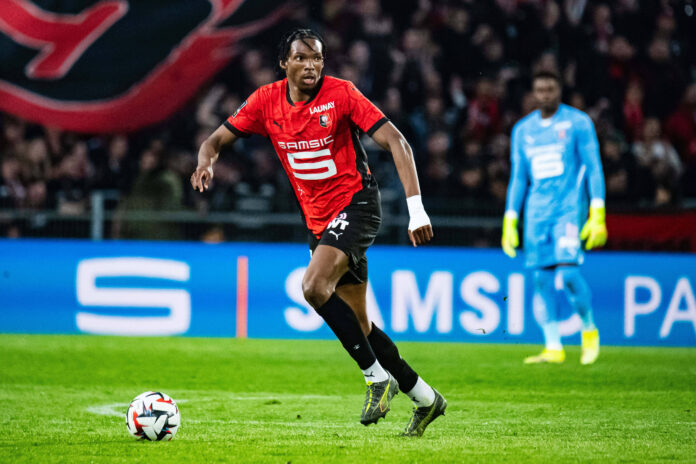
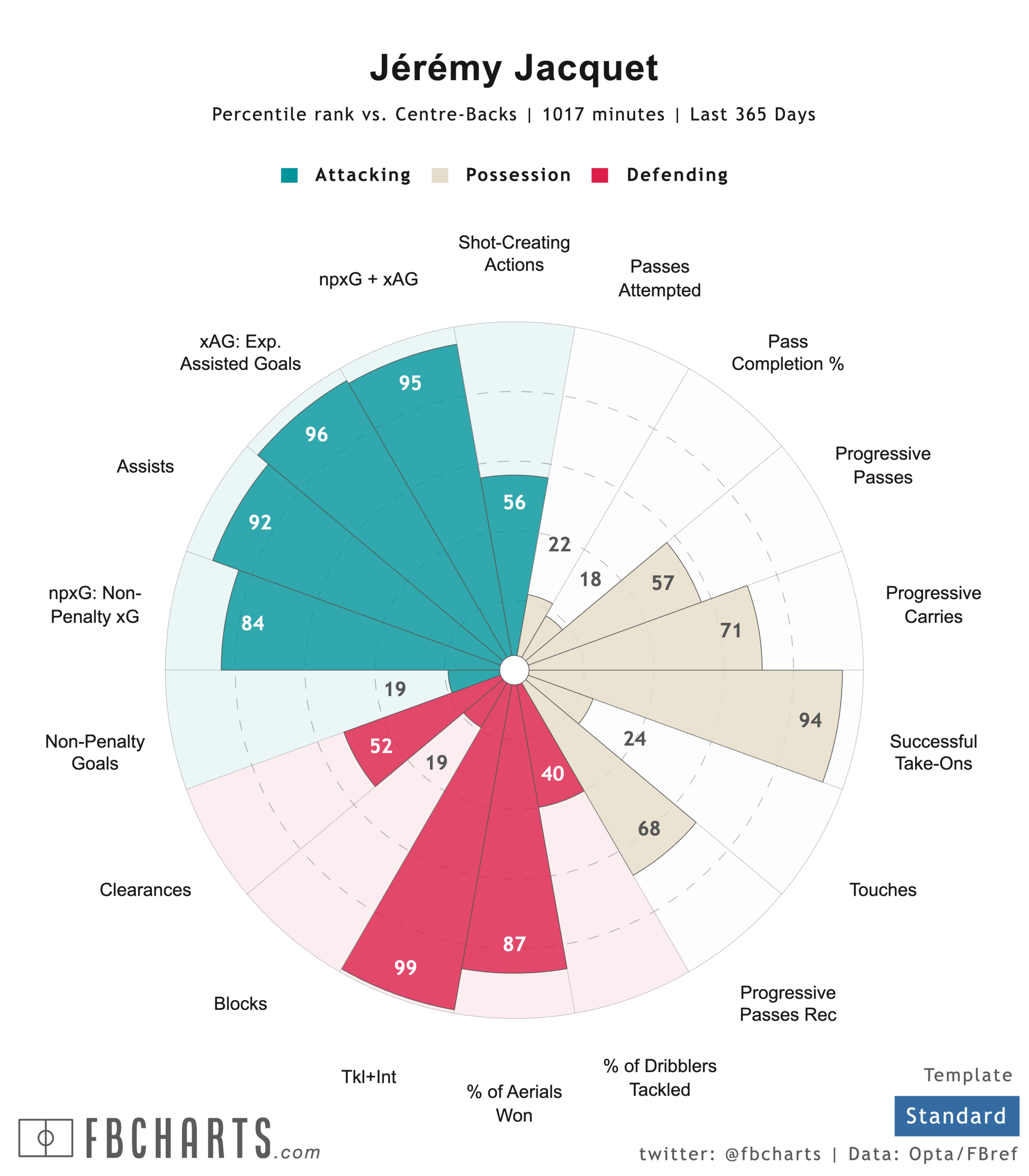
Jacquet’s appeal lies in his raw materials. He is physically strong, covers ground well, and shows composure in possession. Those traits are foundational rather than final, but they align closely with what Liverpool expect from defenders operating in large spaces and under sustained pressure.
Technical Calm and Decision-Making Under Pressure
Barter repeatedly returned to Jacquet’s comfort on the ball. In a system where defenders are required to step into midfield zones and resist aggressive presses, panic is a liability. Jacquet, by contrast, was described as a player who “wants the ball” and does not shy away from responsibility.
That calmness is significant. Liverpool’s defensive structure relies on centre-backs who can interpret space rather than simply react to danger. Jacquet’s willingness to engage with possession suggests a temperament suited to that environment, even if refinement is still required.
Importantly, Barter also highlighted that development is not linear. Some defenders accelerate quickly, others plateau before progressing again. Liverpool’s willingness to allow that process to unfold away from immediate scrutiny has been a recurring feature of their squad planning.
Physical Profile Aligned With Tactical Demands
Physically, Jacquet was characterised as robust without being limited to destruction. He engages in duels, covers space effectively, and has the athletic capacity to defend higher up the pitch. That balance matters in a system that asks defenders to protect large transitional zones rather than sit deep.
Liverpool’s interest, as discussed, is not rooted in raw strength alone. It is about whether a defender can combine physicality with spatial awareness and decision-making. Jacquet appears to meet that baseline, even if refinement remains part of the equation.
A Controlled Bet Rather Than a Risk
From a squad-building perspective, Barter framed Jacquet as a controlled bet. Liverpool are not placing immediate defensive stability on his shoulders. Instead, he would be part of a layered approach, one that allows growth without exposure.
“You’re betting on the upside,” Barter noted, “but you’re doing it in a controlled way.” That distinction matters. Liverpool have rarely pursued defenders as emergency solutions. Even when depth has been tested, the club’s preference has been coherence over panic.
Jacquet’s potential value, therefore, is not confined to the next season. It sits two or three years down the line, shaped by coaching, tactical education, and physical development.
Process Over Urgency Once Again
What ultimately emerges from the combined discussion is clarity. Liverpool are not chasing Jacquet because of market noise or short-term gaps. They are exploring him because his profile fits a system already defined.
Whether a move materialises remains uncertain. As emphasised on Anfield Index, Liverpool will have multiple options under consideration, and patience remains a defining trait. But the logic behind Jacquet’s inclusion in those conversations is consistent with how the club has operated at its most successful.
In Jacquet, Liverpool see possibility rather than immediacy. And history suggests that, more often than not, this is where their recruitment decisions are at their most effective.