
Liverpool and Tommy Hilfiger Redefine Football’s Cultural Reach Through Landmark Global Partnership
Liverpool Football Club has always understood that its influence extends far beyond the white lines of the pitch. It is a club shaped as much by culture as by competition, by identity as much as by silverware. That sense of scale and self-awareness sits at the heart of a new global partnership with Tommy Hilfiger, a collaboration that feels less like a sponsorship deal and more like a statement of intent.
Announced by Liverpool FC earlier today, the agreement marks the first time the American fashion house has entered into a partnership with a football club anywhere in the world. That alone underlines the significance. This is not simply another logo alignment. It is a deliberate crossing of worlds: football, fashion, heritage and modern identity, meeting on equal terms.
As outlined in the original source published on LiverpoolFC.com, the partnership will see Tommy Hilfiger styling integrated across the men’s and women’s squads, as well as key backroom staff, appearing at selected matchdays, global campaigns and cultural moments throughout the season. It is designed to unfold gradually, deliberately, across the rhythm of the football calendar.
Football Identity Meets Global Style
At its core, this collaboration reflects a shared understanding of storytelling. Liverpool’s history is one of resilience, belief and collective pride, values that Tommy Hilfiger has long drawn upon in its own brand mythology. The partnership leans heavily into that overlap, positioning fashion not as decoration, but as expression.
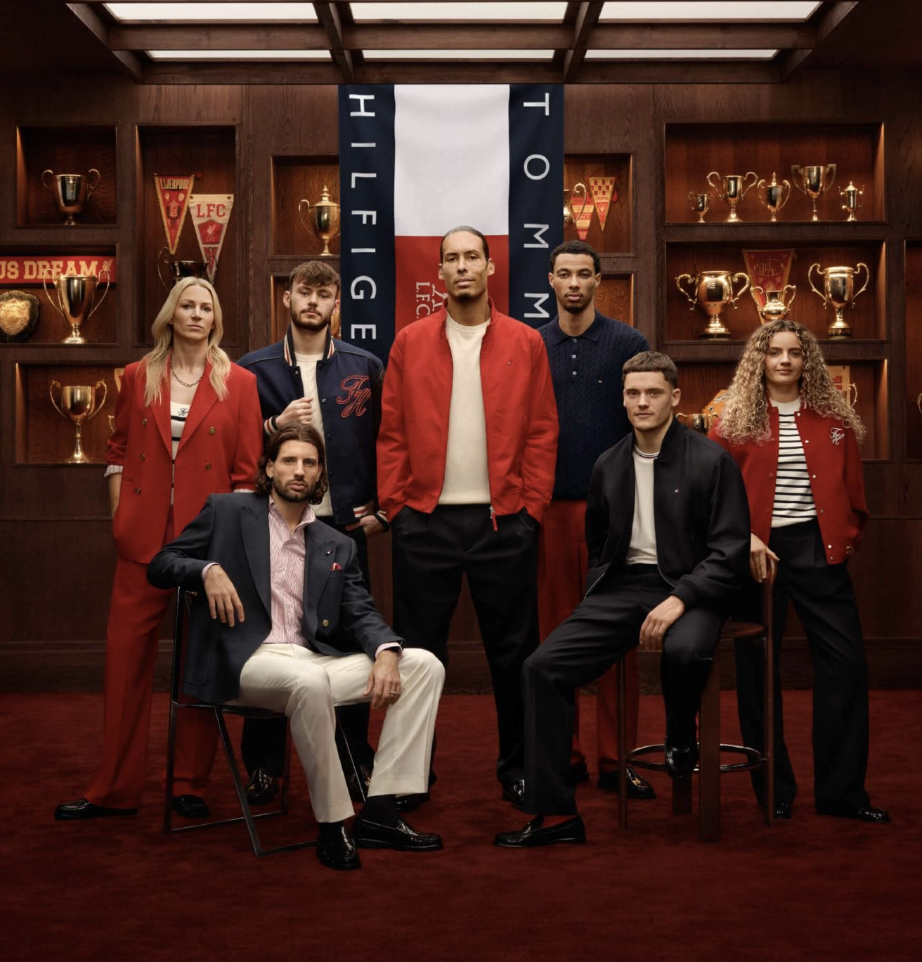
Players such as Virgil van Dijk have been central to the launch, lending both visibility and credibility to the project. “We as players are excited to see the collaboration come to life,” the Liverpool captain said, highlighting the way fashion, culture and heritage intersect within the modern game.
The imagery and campaigns accompanying the announcement draw from both worlds. New York’s preppy heritage meets the industrial grit of Merseyside. Confidence, individuality and collective identity sit side by side. It is football presented not just as sport, but as culture with global resonance.
Beyond Matchday Sponsorship
Crucially, this partnership is not confined to static branding or commercial placements. Instead, it is built around narrative continuity. Seasonal collections, co-branded capsules and curated wardrobes will be rolled out alongside the football calendar, offering supporters a different way to connect with the club and its players.
Ben Latty, Liverpool’s chief commercial officer, described the deal as a natural fit, noting that Tommy Hilfiger’s entry into club football required a partner with genuine global reach and cultural credibility. Liverpool, with its worldwide fanbase and deeply rooted identity, provides exactly that.
This is also a partnership that spans both the men’s and women’s teams, reinforcing the club’s broader commitment to equality and visibility across all levels of the organisation. Fashion, in this context, becomes a unifying language rather than a marketing afterthought.
Anfield as a Cultural Stage
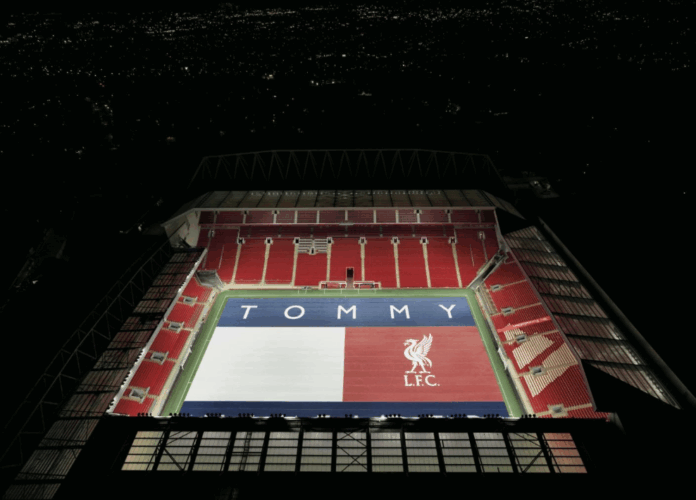
Perhaps the most striking symbol of the partnership came with its announcement at Anfield, where the largest Tommy Hilfiger flag ever produced was unfurled across the pitch. Measuring more than 100 metres in length, it transformed the stadium into a canvas, blending club heritage with global fashion theatre.
The gesture carried additional meaning through the donation of the fabric to the Silly Goose Foundation, linking the spectacle to community impact. It reinforced the idea that this partnership is not only about image, but about shared values and responsibility.
For Tommy Hilfiger himself, the attraction lay in Liverpool’s people as much as its trophies. He spoke of admiration for teams shaped by belief, resilience and pride, traits that have long defined the club’s relationship with its supporters.
A New Template for Global Partnerships
In an era where football sponsorships often blur into sameness, this collaboration stands out for its ambition. It challenges the idea that partnerships must remain transactional. Instead, it positions football clubs as cultural institutions capable of shaping global narratives beyond sport.
For Liverpool, it is another step in redefining what modern football representation looks like under evolving commercial and cultural pressures. For Tommy Hilfiger, it is a carefully chosen entry point into the world’s most powerful sport, anchored by authenticity rather than reach alone.
As global partnerships continue to shape football’s future, this one feels less like an experiment and more like a blueprint.
Word count: 738