
Szoboszlai, Responsibility and the Value of a Mistake at Anfield
There are football matches that unfold exactly as planned, and then there are those that briefly wobble before settling into something more revealing. Liverpool’s 4-1 FA Cup win over Barnsley belonged firmly in the latter category. Comfortable on the scoreboard, occasionally uncomfortable in execution, it became an evening defined less by dominance and more by what happened in the space between control and error.
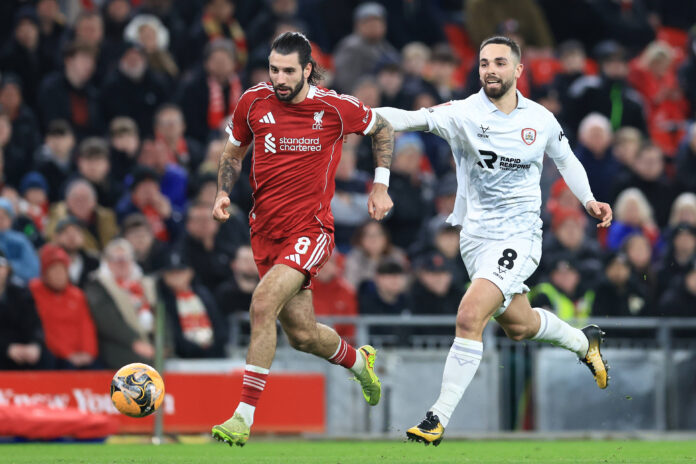
At the centre of that space stood Dominik Szoboszlai. He scored early, made a costly mistake, and then spoke with a candour that felt increasingly rare in elite football. As reported by Liverpoolfc.com in their post-match reaction piece, the midfielder did not seek to minimise his error. He acknowledged it, apologised for it, and then moved on. In doing so, he offered a neat summary of both the game and the wider lesson Liverpool took from it.

Early authority and individual quality
Liverpool began the night with purpose. Rotation was heavy, rhythm initially uncertain, but the intent was clear. Szoboszlai’s opening goal cut through any early nerves. Positioned outside the box, he did not hesitate. The shot was clean, decisive and emblematic of why Liverpool value him so highly: power married to confidence, technique backed by conviction.
That early breakthrough set the tone. Barnsley, organised and industrious, were quickly reminded of the gulf in quality. Liverpool moved the ball with speed, stretched the pitch, and began to dictate terms. Jeremie Frimpong’s first-half goal doubled the lead and appeared to place the tie beyond doubt. At that point, the contest looked set to drift gently towards a routine conclusion.
Football, of course, rarely allows such convenience.
Mistake, response and accountability
The game’s pivot came not from sustained pressure or tactical ingenuity, but from a moment of human error. Szoboszlai, dropping deep inside his own area, misjudged a simple situation. Barnsley capitalised, reducing the deficit and briefly unsettling the home crowd.
Mistakes of this kind are often glossed over in victory. This one was not. Szoboszlai addressed it directly after the final whistle, admitting he had made life harder for his team. There was no deflection, no attempt to contextualise it away. Just acceptance.
That honesty mattered. Not because the mistake threatened Liverpool’s progress – it did not – but because it underlined something important about how this squad is being shaped. Accountability is not reserved for defeats. It exists even when the scoreboard is forgiving.
Squad depth and collective trust
If Szoboszlai’s error introduced uncertainty, Liverpool’s response removed it just as efficiently. Changes from the bench restored control and sharpened the edge. Florian Wirtz and Hugo Ekitike both found the net, turning a potentially awkward evening into a clear statement of depth.
This, more than the goals themselves, was the night’s enduring theme. Liverpool’s head coach made six changes from the previous match, yet the structure held. New combinations found understanding quickly enough. Those on the fringes contributed without looking like passengers.
Szoboszlai reflected on this afterwards, noting that the performance demonstrated the need for the whole squad. It was not said as a platitude. It was said because the match demanded it. Rotation exposed small vulnerabilities, but it also revealed resilience.
Progress measured beyond the scoreline
FA Cup ties against lower-league opposition are often judged harshly. Win too narrowly and questions are asked. Win comfortably and the achievement is dismissed. This one sat somewhere in between, which made it more instructive.
Liverpool progressed, as expected. They scored four, created chances, and never truly looked in danger. Yet within that framework sat moments that mattered: a mistake owned, a response delivered, and a reminder that success is rarely linear.
Szoboszlai’s night encapsulated that truth. A goal, an error, and a mature assessment of both. In a competition that often exposes complacency, Liverpool instead found confirmation of something more valuable. Not perfection, but progress built on responsibility.