
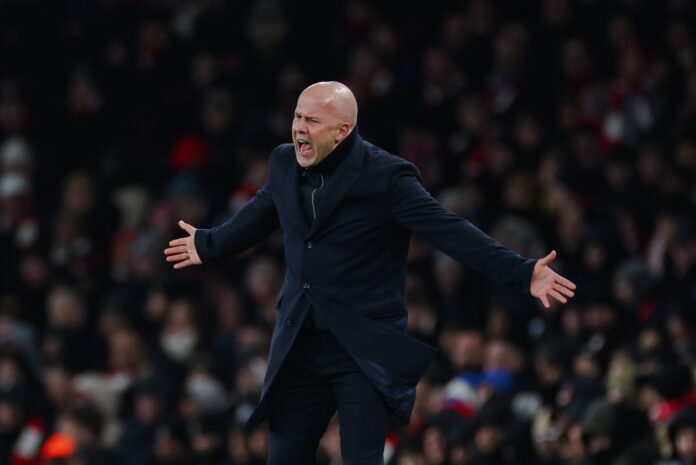

Simon Jordan urges patience as Arne Slot navigates Liverpool’s defining season
Liverpool exist in a perpetual state of scrutiny, where success rarely quietens debate and uncertainty is treated as an invitation for speculation. Even a title-winning campaign can become a prelude to doubt rather than a conclusion. That is the environment Arne Slot currently inhabits, and it is why the sudden noise around Xabi Alonso has felt both predictable and premature.
The original source of this discussion comes from TalkSport, where the idea of managerial succession has bubbled up not because Liverpool are failing, but because the modern football cycle rarely pauses to take stock. Into that churn stepped Simon Jordan, offering a perspective that cuts against the prevailing restlessness surrounding Liverpool and their head coach.
Slot arrived carrying the weight of inheritance, tasked not with rebuilding ruins but with sustaining something already revered. That distinction matters. Jordan’s intervention is notable because it frames Slot not as a placeholder, but as a coach deserving time, context and trust.
Why Simon Jordan sees stability rather than crisis
Speaking on talkSPORT, Simon Jordan dismissed the idea that Liverpool should be eyeing immediate alternatives if results wobble. His assessment was blunt and unambiguous. “You look at it and go, where does he go? Liverpool if Slot fails, but Slot’s not going to fail,” Jordan said.
That confidence is rooted in Slot’s first season, which delivered silverware and validation in equal measure. Jordan continued: “Slot’s had a great first season.” In an era where even short-term success is often reframed as luck or legacy, Jordan’s refusal to detach Slot from his achievements feels significant.
There is also an acknowledgement of rhythm within elite management. Jordan compared Slot’s current campaign to a familiar pattern from Liverpool’s recent past, saying: “He’s having a little bit of a sabbatical in his second season like Jurgen Klopp did when he won the Premier League and people still idolise him.” The implication is clear. Fluctuation does not equal failure. It is often the cost of sustaining intensity at the highest level.
Jordan finished his point with a plea that feels increasingly rare in modern football discourse: “So give Slot a little bit of latitude here.” In six words, he articulated what many clubs abandon too quickly.
Arne Slot’s Liverpool measured over time not noise
Slot’s Liverpool have not always been entertaining in recent months. That much is hard to deny. Performances have dipped, control has occasionally frayed, and the aura of inevitability that surrounded the title run has softened. Yet none of that exists in isolation.
Liverpool remain alive in Europe, and their Champions League position is healthier than the mood around the club might suggest. They sit within reach of a top-eight finish, a position that would fundamentally alter the complexion of their continental campaign. Jordan’s argument implicitly leans on this broader horizon. Seasons are not defined in January.
Slot has also demonstrated tactical adaptability against elite opposition, including victories over some of Europe’s most admired coaches. Those results matter because they speak to ceiling, not just consistency. This Liverpool side may be imperfect, but it is not regressing into chaos.
Xabi Alonso links and Liverpool’s familiar temptation
The allure of Xabi Alonso is understandable. His Liverpool history, combined with his growing reputation on the continent, makes him a compelling figure in abstract. But abstract thinking is often dangerous in football governance. Jordan’s comments serve as a reminder that admiration for potential should not override evidence in the present.
Liverpool have seen this story before, where impatience risks destabilising what is still fundamentally functional. Slot has not lost the dressing room, nor the tactical thread of his side. He is navigating the less glamorous phase of management, where evolution happens quietly rather than triumphantly.
The question is not whether Liverpool could one day consider a different direction, but whether now is remotely the moment. Jordan’s answer, delivered without hesitation, is no.
Patience as Liverpool’s competitive advantage
What separates successful eras from short-lived ones is often restraint. Liverpool’s recent history has been defined by belief in process, even when results temporarily faltered. Jordan’s defence of Slot echoes that philosophy.
Liverpool are not drifting. They are competing, adapting and, crucially, still learning what Slot’s version of the club will ultimately become. To abandon that journey prematurely would be to misunderstand the very foundations of sustained success.
As Jordan made clear, this is not a manager clinging on, but one who has already shown he belongs. The challenge now is not replacing him, but allowing his work to breathe.