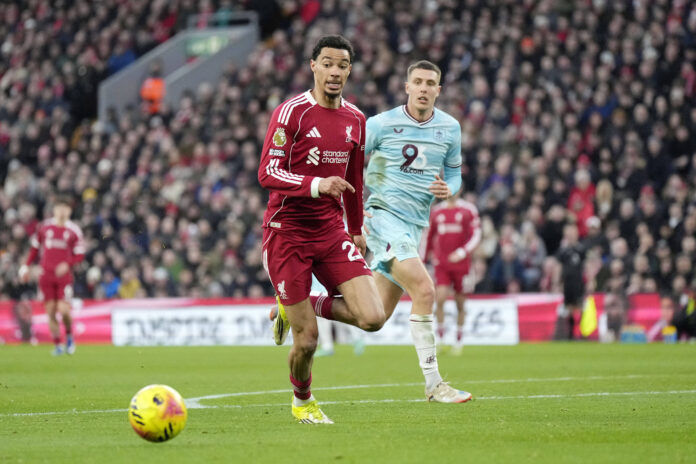

There are football clubs that reward certainty. You can watch them for ten minutes and feel you understand the shape of the evening ahead. Liverpool have never belonged to that category. Their matches have a tendency to shift tone, pace and logic without warning, often more than once. Supporters know this instinctively. It is why nobody at Anfield ever settles too early, no matter what the scoreboard says.
This is not simply about drama for its own sake. It is structural. Liverpool’s identity under recent managers has been built on intensity, momentum and emotional pressure. These are qualities that amplify change rather than suppress it. When things are going well, they snowball. When something disrupts the flow, the response can be immediate and unpredictable. Matches rarely stay where they begin.
Watch enough Liverpool games and patterns emerge, though not the tidy kind analysts prefer. A strong opening can fade. A shaky first half can turn electric after the break. One substitution, one crowd surge, one moment of chaos can reset the entire contest. The idea of a linear ninety minutes does not apply here.
It is in these moments of flux that modern fan behaviour has evolved. Supporters do not simply watch and wait anymore. They react, reassess and recalibrate as the game unfolds, whether through debate or even live football betting as momentum swings and assumptions are challenged in real time. Liverpool matches invite that constant re-evaluation because they demand it.
Why Early Conclusions Rarely Survive
Liverpool have made a habit of undermining early narratives. A fast start does not guarantee control. A sluggish opening does not rule out dominance later. This is partly tactical and partly psychological. The team is built to press, to recover, to overwhelm when rhythm returns.
Opponents often begin with a plan that works, briefly. Liverpool absorb it, adjust, and then apply pressure in waves. When those waves arrive, matches tilt. What looked stable becomes fragile. What felt inevitable becomes negotiable.
Supporters have learned not to trust the first act and wait for the mature performance. The real story often arrives later as we have seen recently with Arsenal.
Momentum as a Moving Target
Few clubs lean into momentum the way Liverpool do. It is not just about possession or territory. It is about belief spreading from pitch to stands and back again. When Anfield senses a shift, it amplifies it.
This is why leads can feel temporary and deficits feel manageable. Momentum is treated as something that can be summoned rather than endured. That belief changes how games are experienced. A single tackle, a burst of pressure, a reaction from the crowd can change the emotional temperature instantly.
From the outside, this can look chaotic. From within, it feels purposeful.
Tactical Adjustments That Change the Story
Liverpool’s in-game management has often been decisive. Changes are not always dramatic, but they are timely. A press tweak. A full-back pushed higher. A forward asked to drift wider. These adjustments do not announce themselves, but their effects ripple.
Opponents who believed they had control found the ground shifting. Passing lanes close. Pressing angles sharpen. Space disappears. The match rewrites itself not through one moment, but through accumulation.
This is why Liverpool matches demand attention. Drift for five minutes and you can miss the turn.
The Emotional Cost for Supporters
This constant rewriting is exhilarating, but it is also exhausting. Liverpool fans live with heightened awareness. Comfort is brief. Relief is provisional. Joy often arrives late and leaves the heart racing.
Yet this is part of the bond. Supporters do not follow Liverpool for calm resolution. They follow because the games feel alive. Because certainty is never assumed. Because belief is always tested.
The relationship is built on shared tension as much as shared triumph.
Why This Style Endures
In a sport increasingly shaped by control and risk management, Liverpool’s volatility stands out. It resists reduction. It refuses to settle into predictable rhythms. That unpredictability keeps matches engaging long after patterns elsewhere have become familiar.
It also reflects the club’s identity. Liverpool have always been a wholesome club that has thrived on emotion, momentum and the sense that something can change at any moment. That tradition continues, even as tactics evolve.
Expect the Rewrite
Liverpool matches rarely tell you the truth straight away. They circle it, tease it, then reveal it late. Supporters know this and adjust their expectations accordingly. They watch not for confirmation, but for the turn.
It is why nobody leaves early. Why does nobody relax at 2–0. Why is every phase treated as provisional?
Liverpool do not just play the game in front of them. They rewrite it as they go.