

Mateus Mane, Instagram and a Hint of Liverpool’s Next Evolution
Liverpool’s future, as ever, is being shaped in fragments rather than announcements. A social media interaction here, a stylistic requirement there, and suddenly a narrative begins to form. In recent days, that narrative has centred on Mateus Mane, a young winger whose name has begun to circulate with increasing frequency around Anfield. Not because of a bid, or a briefing, but because of a fleeting moment on Instagram that felt quietly revealing.
Transfer stories used to arrive with a sense of ceremony. Now they often drift in through the side door, carried on a screenshot, a like, or a moment of digital carelessness. Mane’s apparent openness to Liverpool belongs firmly to that modern genre, but it still tells us something useful about where the club believe their next steps must lead.
Liverpool’s tactical need for speed and width
Liverpool’s current iteration has been defined less by what it does than by what it lacks. Under Arne Slot, the emphasis has shifted towards controlled possession and positional discipline, but the absence of consistent pace in wide areas has been increasingly evident. Transitions have slowed. Space is not being attacked with the same ferocity. The wings, once a source of chaos, have become predictable.
This is not an ideological failure, but a structural one. Slot’s system requires wide players capable of isolating defenders, winning one-v-one duels and accelerating play vertically. Without that profile, the shape can look sterile, particularly against compact Premier League blocks.
That is why recruitment chief Richard Hughes is expected to prioritise attacking reinforcements in the summer. Liverpool do not simply need depth. They need a specific type of winger, one who restores intensity without sacrificing control. In that context, Mane’s emergence as a potential option makes intuitive sense.
Mateus Mane and emergence at Wolves
Mateus Mane’s rise has been gradual rather than explosive, but it has been built on traits that Liverpool value highly. At Wolves, he has been afforded the freedom to express himself in wide areas, and his development has reflected that trust. Direct, fearless, and increasingly efficient, Mane has shown a willingness to take responsibility in moments that demand it.
What stands out is not just his pace, but his intent. He carries the ball with purpose, looking to advance play rather than recycle it. In one-v-one situations, he commits defenders and creates separation. These are qualities Liverpool’s system has been missing at times, particularly in matches where control without incision has proven insufficient.
Premier League interest is inevitable. Clubs monitor profiles like this constantly, especially when a player demonstrates both physical readiness and tactical adaptability. Mane fits that bracket, and his age suggests room for further growth rather than immediate peak performance.
Instagram activity and modern transfer signalling
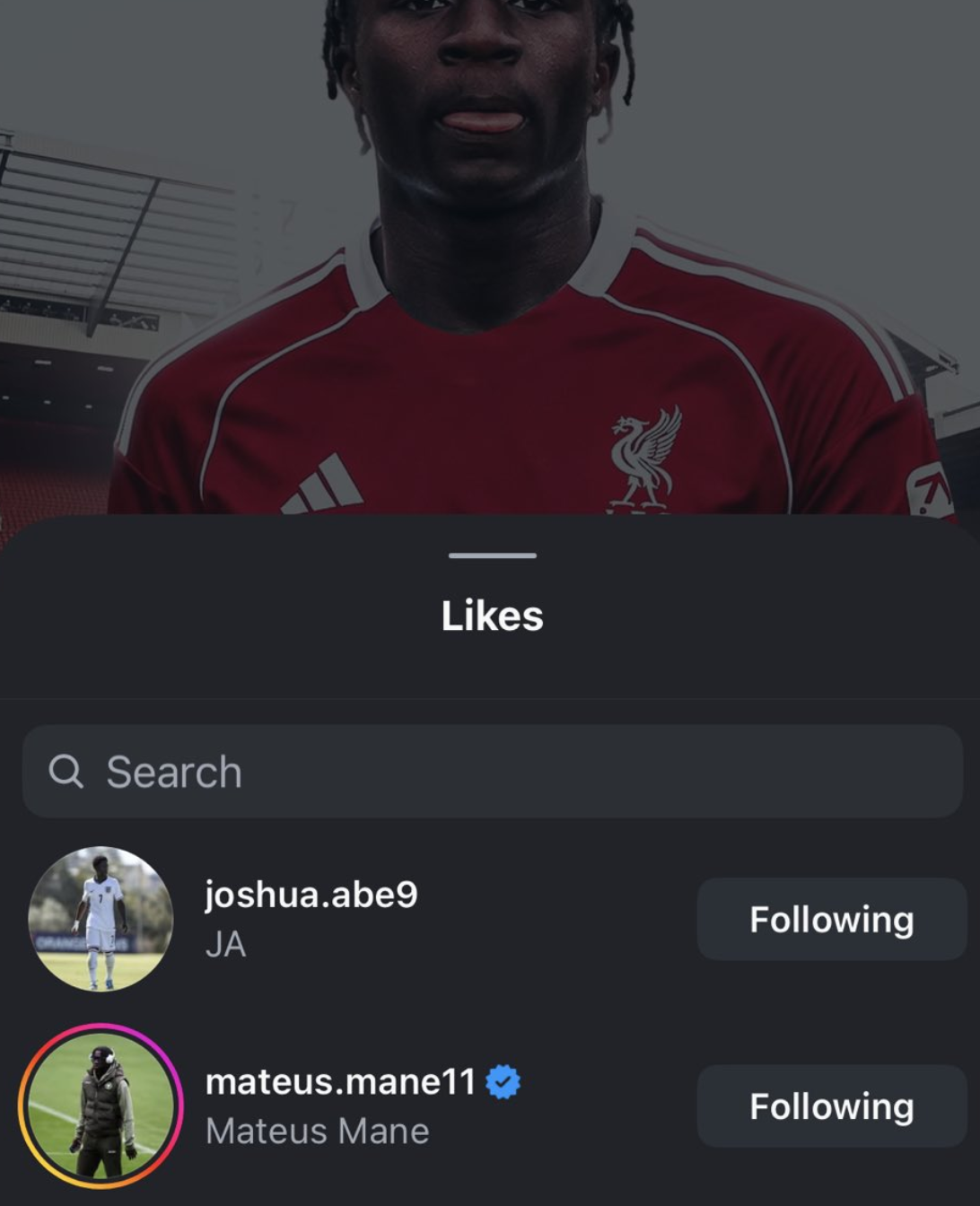
What has elevated Mane from scouting note to headline, however, is a moment of online behaviour. An Instagram post linking him with Liverpool received a like from the player himself, a detail later removed but preserved in screenshot form by an eagle-eyed supporter. It was subsequently shared on X, ensuring its circulation far beyond its original audience.
In isolation, such moments mean very little. Players interact with content casually, often without strategic intent. Yet in the modern transfer ecosystem, perception matters. Likes are read as signals, however unreliable. They create a sense of openness, of possibility.
Squad building lessons from Liverpool’s past
Liverpool’s history offers a useful reminder here. Squad construction at elite level is rarely immediate. Jurgen Klopp’s most successful side did not arrive fully formed. It took several windows before the final pieces were in place, culminating in the addition of a transformative centre-back who completed the puzzle rather than redefining it.
The same patience will be required now. Liverpool are not chasing instant solutions, but coherence. Wide players like Mane represent potential building blocks rather than saviours. They are judged not just on output, but on how they fit a tactical vision that values intensity, timing and positional intelligence.
If Liverpool do move for Mane, it will not be because of an Instagram like. It will be because his profile aligns with what Slot’s system demands, and because the club believe he can grow into that role over time. For now, the story remains suggestive rather than definitive, a modern transfer whisper carried on a digital platform.