
Robertson, Liverpool and Potential Tottenham Deal
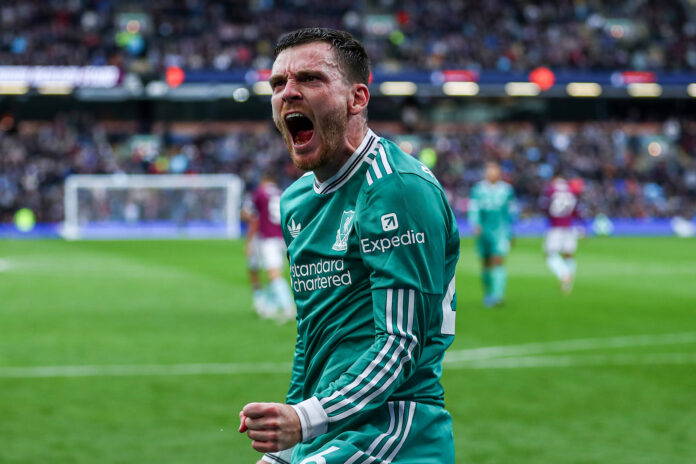
There is something quietly symbolic about Tottenham Hotspur’s pursuit of Andy Robertson. It is not just a move about depth, injury cover, or short-term fixes. It is about timing, identity, and what happens when football’s most dependable figures begin to feel the clock ticking louder than the crowd.
According to reporting from The Athletic, Tottenham are working on a deal to sign the Liverpool left-back ahead of the expiry of his contract in June. What was initially planned as a free transfer has now been accelerated, driven by Spurs’ need for immediate stability and leadership.
Robertson, at 31, stands at one of football’s invisible crossroads: still good enough, still driven, but no longer guaranteed the central role he once owned.
https://twitter.com/David_Ornstein/status/2014656867264352680
Robertson’s Changing Role at Liverpool
For nearly a decade, Andy Robertson was a constant at Anfield. A relentless runner, a touchline metronome, a player who seemed engineered for the emotional and physical demands of Liverpool under Jurgen Klopp.
But football rarely pauses for sentiment.
The arrival of Milos Kerkez last summer for £40 million shifted the balance. Robertson, once undroppable, has started just four Premier League games this season. His total of 21 appearances across competitions reflects usefulness, not centrality.
There is no drama in this decline. No falling-out. No public discontent. Instead, there is quiet acceptance. Robertson himself admitted recently that he is “a player who wants to play”, acknowledging that decisions about his future must now involve his family as much as his football.
Liverpool, meanwhile, remain pragmatic. They could recall Kostas Tsimikas from Roma if needed. They have succession planning in place. They have already moved on, even while respecting what remains.
It is the modern elite club’s way: honour the past, invest in the future.
Tottenham’s Search for Experience and Stability
Tottenham’s interest in Robertson says as much about them as it does about him.
Injury has hollowed out their defensive structure. Destiny Udogie has been limited to 10 league games. Ben Davies is heading for surgery. Djed Spence, Archie Gray and Micky van de Ven have all been used out of position.
It has been functional. It has not been convincing.
Thomas Frank has inherited a squad that often looks talented but emotionally lightweight. Spurs sit fifth in the Champions League group phase, respectable in Europe, erratic at home. They lack ballast. They lack players who have lived through title races and survived them.
Robertson brings that.
Two Premier League titles. A Champions League medal. Nearly 400 appearances for Liverpool. He understands elite standards. He knows how dressing rooms operate under pressure. He knows what “normal” looks like at the top.
For Tottenham, that experience is not a luxury. It is a necessity.
Loyalty, Legacy and Liverpool’s Long Goodbye
Robertson’s relationship with Liverpool has always been built on mutual respect. Signed from Hull in 2017 with minimal fanfare, he became a defining figure of an era. His energy, aggression and emotional commitment set the tone as much as his assists.
He was never just a full-back. He was a cultural carrier.
That is why any exit will be handled carefully. Liverpool will not force him out. Robertson will not leave in a way that harms the club. Both sides understand what they owe each other.
As The Athletic noted, negotiations are amicable. This is a conversation between adults, not agents playing brinkmanship.
There is also the Scotland factor. Robertson is set to captain his country at the World Cup. Regular football matters. Momentum matters. Sitting on a bench does not suit a player whose entire career has been built on rhythm and repetition.
Leaving Liverpool will hurt. But staying peripheral may hurt more.
This is what dignified decline looks like in elite football: managed, negotiated, and largely respectful.
Why This Move Makes Sense for Both Clubs
From a distance, this transfer looks logical.
Tottenham gain leadership, reliability and professionalism. Robertson may no longer be the explosive runner of 2019, but he remains tactically intelligent, positionally sound and fiercely competitive. He will raise training standards. He will set expectations.
Liverpool gain clarity. Kerkez becomes undisputed first choice. Squad planning simplifies. Resources can be redirected towards long-term recruitment.
There will be short-term risks. Depth will be thinner. A recall for Tsimikas may be required. Another left-back will eventually need signing.
But transitions are unavoidable.
Robertson has made 363 appearances, scored 12 goals and delivered 68 assists. He helped build one of the most successful Liverpool sides in modern history. That legacy is secure.
What comes next is about relevance rather than remembrance.
For Spurs, this is a statement of intent. Not glamorous. Not headline-grabbing. But serious.
For Robertson, it is a chance to feel central again.
And in football, that feeling is often worth more than loyalty, nostalgia, or even medals.
Sometimes, the bravest move is knowing when to leave.