
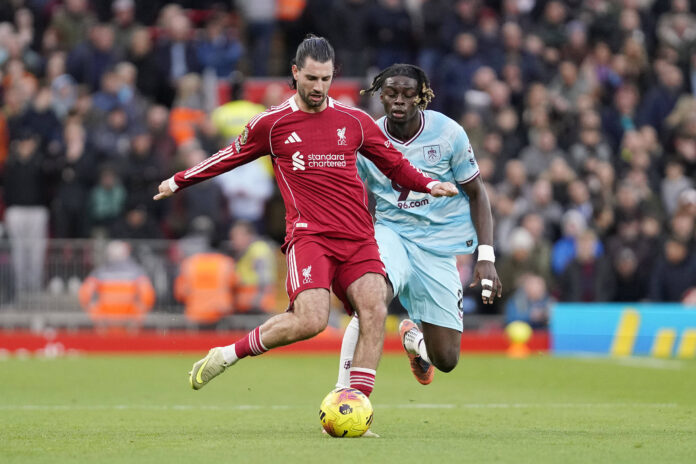

Liverpool have always had speed in their core. Even when the team’s style changed, there was usually at least one player on the pitch who made defenders look slow and weak. Sometimes it was raw, straight line sprinting. Sometimes it was unbelievable for the first ten meters where the full back was already panicking. And in the modern era, we’ve even got actual numbers to back up the eye test.
Before we jump into names, it’s worth saying this out loud: “fastest” can mean a few different things. There’s top speed, the quickest number a player hits at full sprint, acceleration, how quickly they get up to speed, and “game speed” meaning how fast they look when they’re dribbling, changing direction, and making decisions. Liverpool’s best speedsters usually had at least two of those, and the truly scary ones had all three.
Let’s take a tour through Liverpool’s quickest players across eras, mixing the legends with the modern guys whose sprint speeds actually get recorded and published.
What “Fastest” Actually Means in the Modern Game
The headline stat everyone loves is top speed: the maximum km/h a player hits.
But Liverpool’s style, especially the high intensity years and even now in transition moments cares about more than one number. There’s also acceleration, first steps, repeat sprints, how often you can hit high speed, and recovery pace, how quickly you can erase danger when the press gets broken. The funniest part is that a player can be “fast” in one of those ways and still feel slow in another. That’s why we’re going to consider two aspects, the numbers, and how those numbers actually show up in a match.
Dominik Szoboszlai Is Liverpool’s Modern Speed King
If you want one Liverpool pace flex that’s as official as it gets, it’s Dominik Szoboszlai at 36.76 km/h. The Premier League published its data and had Szoboszlai right near the very top with a recorded top speed of 36.76 km/h, hit in Wolves vs Liverpool, which puts him as the fastest player in the world who isplaying in Liverpool.
A midfielder hitting 36.76 is genuinely remarkable. Midfielders usually run a ton, but it’s often in traffic like turns, checks, sideways shuffles, press angles, little bursts. You don’t always get that long open runway sprint that wingers and strikers live for. So when a midfielder posts a number like that, it says two things at once. One, he’s got real top end speed. Two, he’s athletic enough to access it inside an actual match, not only in training.
Szoboszlai’s pace turns messy moments into advantages
If Liverpool wins the ball and the game opens up for two seconds, he’s one of the guys who can immediately launch into that space and make it a proper attack. If Liverpool gets caught high and someone breaks through, he’s also one of the guys who can actually get back and put out the fire. That’s what a modern pace does for a team. It’s not just highlight reel sprinting. It’s tactical insurance.
Luis Díaz Was Officially in Liverpool’s Top speed Elite
During 2023/24, the Premier League’s official “fastest players” list had Díaz recorded at 36.42 km/h (Burnley vs Liverpool), putting him inside the league’s top 10 tracked speeds at the time.
That number makes total sense if you watched him regularly at Liverpool. Díaz wasn’t just quick in a straight line, he was quick in that start stop tactics that tortures defenders because it’s not predictable. You could see full backs trying to time their tackles and just missing the moment because Díaz’s next step arrived faster than they expected.
Even though Díaz went to Bayern in mid 2025, he still remains one of the best and fastest Liverpool players.
Salah Is Still the Guy Who Wins the First Three Steps
Salah is funny because people sometimes talk about him like he’s more sharp than fast, mostly because his running style is smooth. He doesn’t look like he’s sprinting the way some wingers do, all arms and fury. He glides. Then you look up and realize the defender is two steps behind and staying two steps behind.
Mohamed Salah’s fastest recorded Premier League top speed is 36.64 km/h, set in 2021 vs Southampton.
But the reason Salah’s pace is so dangerous is that it’s not isolated. It stacks with everything else. He can sprint while carrying the ball, sprint while shaping to shoot, sprint while taking contact, and still keep control. Lots of fast players lose their threat once you force them wide, or once they have to dribble at speed, or once they get bumped. Salah doesn’t. That’s why he might not be the absolute fastest in the team, but he’s still the one defenders worry about the most.
Virgil Van Dijk Is the Special Kind of Center back
Here’s the funniest speed fact in Liverpool’s modern history. UEFA’s 2018/19 Champions League technical report credited Virgil van Dijk with the fastest sprint of that entire Champions League season at 34.5 km/h, recorded against Barcelona.
A center back hitting 34.5 km/h at Champions League level is ridiculous. It explains so much about how Liverpool could play. When your center back has that recovery pace, you can hold a higher line. Your full backs can be aggressive. Your midfield can press tighter. Basically, Van Dijk’s speed wasn’t just a great addition to the team, but it was structural. It made the whole system safer.
Also, running data even has Van Dijk showing up in the “time spent walking” list, which sounds like shade, but it’s actually a classic elite center back tactic where he conserves energy, reads the game, then explodes when the team needs him.
The best defenders often look like they’re doing less, until you realize they’re doing the right thing at the right moment, with great focus.
Darwin Núñez Was One of Liverpool’s Most Relentless Sprinters
Darwin Núñez left Liverpool in August 2025 but deserves to be on the list as one of the most famous and fastest players in his previous club. The Premier League had Núñez in the top five for proportion of time spent sprinting, listed at 1.07% of his game time sprinting, defined as running over 25 km/h.
That’s an important stat, because it isn’t just about one headline top speed. It’s about how often you’re actually hitting a sprint threshold. Núñez at Liverpool was a chaos runner: channel sprints, pressing sprints, transition sprints, the reversed sprints. Even when his game was messy, his legs were always a problem for opponents because he forced defenders to turn and run, and turning is one thing that defenders fear the most.
So yes, Darwin isn’t at Liverpool anymore but in the tracking era, he absolutely shaped Liverpool’s pace identity.
Joe Gomez is Liverpool’s Greatest Recovery Runner
Not every speedster gets a neat official top speed graphic. Some players are just fast in the moments that save you points. Joe Gomez is one of those.
In elite league football, recovery pace is everything. You can have a perfect press for 30 minutes, and then one bad pass leaves you exposed. The defenders who survive those moments aren’t always the ones who read the game best, though that helps. They’re the ones who can turn and actually catch quick attackers to save the ball, or stop the momentum of the rivals.
Gomez has been that guy for Liverpool across multiple seasons, and his comeback is expected soon to finish the season with the team.
The thing with Gomez is that his pace looks effortless. He doesn’t do dramatic chasing animation. He just eats the ground and closes the gap. When building a modern Liverpool “fast players” list, that’s a kind of speed that deserves to be included, even if the league hasn’t plastered his exact top speed on a headline.
Trent Alexander-Arnold Had a Different Kind of Speed
Trent is worth mentioning in a modern tracking era piece because he was part of Liverpool’s physical profile for years before leaving for Real Madrid. He wasn’t the club’s pure sprint king. His speed was often more about quick decisions, quick switches, and that ability to move the ball faster than opponents could shuffle across. Physically, he was quick enough to overlap and recover, but he wasn’t the fastest on the field in a traditional sense.
His value as part of the team was in his head, his wits, not so much in his legs.
Still, in modern football, full backs get dragged into foot races constantly, and Trent’s ability to cope athletically was part of why Liverpool could play the way they did for so long.
The Reality Check About Liverpool
Here’s something the tracking era makes obvious: speed leaderboards shift fast. One season, Liverpool can have two players in the Premier League top 10 for top speed, which they did in 2023/24 with Szoboszlai (36.76) and Díaz (36.42).
Then the next season, the Premier League’s fastest players 24/25 list might be led by other clubs entirely, with top speeds like 37.1 km/h for Micky van de Ven and 36.7 km/h for Matheus Nunes.
That doesn’t mean Liverpool suddenly became slow. It means two things.
First, top speed mostly depends on the current situation on the field and the opportunity for the player to even hit the ground; you need the right game state and the right run to hit your maximum.
Second, Liverpool’s pace advantage has often been a blend of sprinting volume, pressing intensity, and multiple fast players rather than just one single speed champion every year. They were always a compact team where players were supporting each other, so it’s easier for individual runners to get the space for sprints.
And that’s very Liverpool, honestly. It’s rarely one superstar trait. It’s the whole system that amplifies certain traits.
So, Who’s The Fastest Liverpool Player of the Modern Era?
If you’re using Premier League tracked top speed as the cleanest metric, Szoboszlai’s 36.76 km/h is the strongest, most straightforward Liverpool runner we’ve got in the recent official lists.
If you’re talking about the most “unfair” speed profile across the years, Salah’s pace plus control is still the one that keeps hurting teams even when everyone knows what’s coming. If you want the weirdest flex, Van Dijk being clocked at 34.5 km/h in the Champions League as a center back is still hilarious and still massively relevant to how Liverpool played at their best. And if you want the unconventional pace setters, the constant sprinting and chaos running of Darwin Núñez in 24/25 (before his move) is a real example of how Liverpool used speed as pressure, not just as a highlight.
Now, there are some new players in Liverpool that are most likely to become the club’s next fastest sprinters.
Conor Bradley feels like the obvious one because modern full backs live in repeated sprints overlap, recover, overlap again and he’s exactly that kind of runner.
Milos Kerkez is another strong shout: he’s only 21 and gets talked about in terms of high sprints and relentless up and down work, which is usually the profile that produces big tracking numbers once a player gets settled.
Ben Doak has been described repeatedly as a winger known for extreme speed and direct dribbling, if he nails his pace and stays fit, he’s the kind of player who can win club top speed charts.
And if you want a very simple clue from Liverpool’s own internal comparisons, a report on Liverpool’s squad speed rankings said Jeremie Frimpong came in as the squad’s new fastest after the 2025 summer business, and he’s still in that early 20s age bracket where players can get even quicker.
Liverpool’s fastest modern era players aren’t just sprinters. They’re the ones whose pace changes what’s possible, midfielders who can hit winger speeds, forwards who can separate while controlling the ball, and defenders who can recover fast enough that the whole team can play braver. Liverpool always acted like a team, and not like a gathering of football superstars who are looking to prove their individual skills on the field. That’s what makes them a dangerous opponent, and something that coaches are counting on in every match.