


Liverpool Loan Watch: Vítězslav Jaroš’ Ajax spell cut short but not diminished
Liverpool’s loan strategy has rarely been about shortcuts. It has been about layers, exposure, escalation. For Vítězslav Jaroš, the 2025-26 season at Ajax was supposed to represent the final polish in a carefully managed development cycle. Instead, it ended in cruel fashion, with a serious knee injury bringing his campaign to an abrupt halt.
Yet to focus solely on the injury would be to miss the broader picture. This was a season that confirmed Jaroš belongs at a serious European level.
Development path built on substance
Since arriving from Slavia Prague in 2017, Jaroš has followed a deliberate route. Academy progression, senior training exposure, then increasingly demanding loans. His first senior breakthrough came at St Patrick’s Athletic, where he established himself as number one and helped secure the FAI Cup. Commanding, composed and comfortable behind a high line, he showed temperament early.
Notts County offered a different education, physical football, expectation, pressure. Stockport in League One added another layer, playing for a promotion chasing side that dominated territory. Sturm Graz then entrusted him in league and European competition, where consistency and maturity elevated his profile further.
By the time he rejoined Liverpool’s first team group for 2024-25 under Arne Slot, making 28 matchday squads and debuting in a 1-0 win at Crystal Palace before starting at Brighton in the Carabao Cup, he was no longer simply a promising academy product. He was a goalkeeper hardened by varied experiences.
Ajax opportunity and European exposure
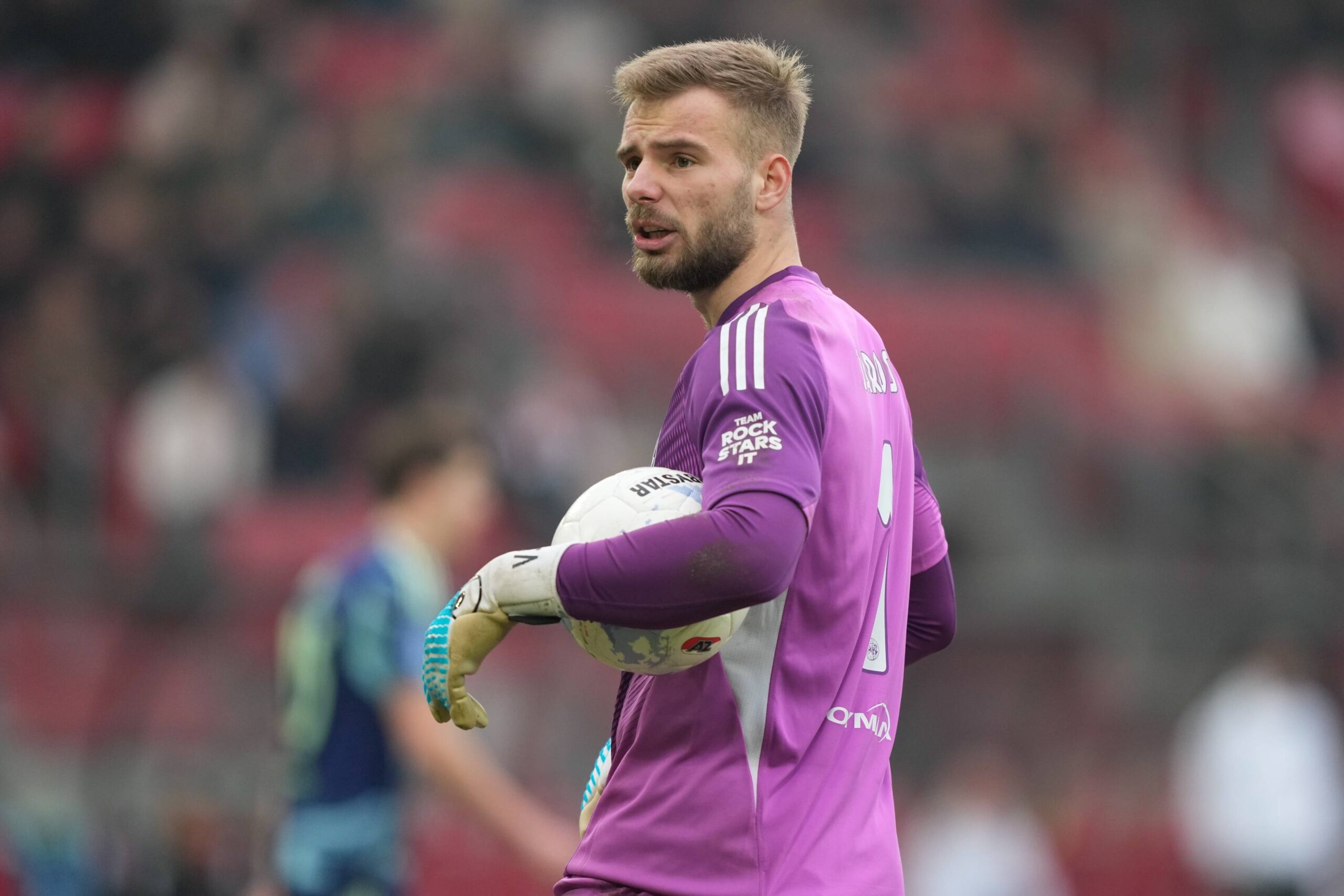
The move to Ajax made stylistic sense. A possession dominant environment, heavy build up responsibility, expectation to play through pressure. He took the number one shirt from August and held it through turbulence both on and off the pitch.
Before the injury announcement from Ajax confirmed surgery would rule him out for the remainder of the season, Jaroš had accumulated 26 starts across the Eredivisie, Champions League and KNVB Beker. For a 24 year old goalkeeper, that volume at that level is significant.
Those are not empty compliments. Ajax endured a difficult domestic campaign, sitting well adrift of PSV Eindhoven and struggling in Europe. Defensive instability was visible across the pitch. Jaroš often found himself sweeping behind a stretched back line and launching longer passes than a peak Ajax side would ideally prefer.
Data profile and stylistic alignment
Statistically, his season reads as steady rather than spectacular. His save percentage sat at a respectable level, saves per 90 indicated regular involvement, and his shot stopping value added hovered around neutral. He was not stealing points with outrageous interventions, but neither was he costing them.
That neutrality often reflects positional discipline and technical cleanliness. Low mistakes in possession, willingness to mix long distribution with throws, comfort under pressure. He fit the Ajax model without overplaying the part.
Importantly, the data hints at context. Higher sweeper actions and long passes suggest Ajax were drawn into transitional games more often than intended. This was not a dominant, suffocating Ajax side compressing the pitch. Jaroš adapted accordingly.
njury aside, Jaroš demonstrated he can anchor a high profile European club through instability. Goalkeepers typically peak between 31 and 35. At 24, he has already logged meaningful minutes in multiple leagues and in the Champions League.
The rehabilitation process now becomes the next test. If managed correctly, this season will be remembered less for its abrupt ending and more as the year Vítězslav Jaroš confirmed he is ready for serious responsibility.