There is a moment in late December 2024 that deserves attention. Liverpool FC added three million new social media followers in a single month. Three million. Not through paid advertising campaigns or viral stunts, but through what the club’s digital team describes as “always-on documentary storytelling.” That month pushed their combined following past the 200-million mark across all men’s and women’s channels — a threshold that sounds almost absurd for a football club founded in 1892 on the banks of the Mersey.
But here is the thing. Follower counts alone tell you very little. The real story — the one most coverage misses — is what happens after someone hits “follow.” And that is where Liverpool have quietly separated themselves from every other club in the English top flight.
The Engagement Gap Nobody Talks About
Let’s start with a number that puts everything into context. In the 2023–24 season, Liverpool registered 1.5 billion fan engagements across their social media platforms. That made them the most-engaged club in the Premier League — not the most followed (Manchester United still holds that crown at roughly 224 million), but the most interacted with. The distinction matters enormously.
By January 2025, the lead had grown. Figures from Blinkfire Analytics showed Liverpool ahead of their nearest Premier League rival by 200 million engagements across Facebook, Instagram, Threads, X, TikTok, and YouTube. Two hundred million. That is not a gap. That is a canyon.
What explains it? Several things, but the short answer is that Liverpool treat their digital channels less like marketing tools and more like storytelling platforms. The “Inside Training” series, the behind-the-scenes matchday content, the original documentaries like “Alisson: My Story” — these are not afterthoughts. They are central to the club’s identity in the digital age. VP of Digital Drew Crisp has spoken openly about using AI-guided content sequencing that blends fan-made clips with official match footage. The result feels organic rather than corporate, which is precisely the point.
Why Instagram Drives 61% of Everything
One data point kept jumping out during research. Instagram accounts for approximately 61 percent of Liverpool’s total social media engagement despite representing only about a quarter of their overall follower count. That imbalance tells you something important about where football fandom actually lives in 2025.
Instagram’s algorithm rewards visual storytelling, short-form video, and emotional content — exactly the kind of material Liverpool produce naturally. A post-match photo of Virgil van Dijk embracing a teammate generates more genuine interaction than a perfectly polished graphic ever could. The club seems to understand this intuitively.
YouTube tells a different story but an equally compelling one. Liverpool became the first Premier League club to receive YouTube’s Diamond Play Button in May 2024 after crossing 10 million subscribers. By early 2025, that number surpassed 11 million. The channel now operates less like a highlights reel and more like a streaming service, with full-length documentaries, tactical breakdowns, and archival footage stretching back decades.
For anyone interested in how football analytics and data-driven content have reshaped the way supporters consume the modern game, Liverpool’s approach provides a case study worth examining in detail.
The Geography of Digital Fandom
Here is something the raw follower numbers obscure: the geographic spread of Liverpool’s digital fanbase is genuinely global in a way that goes beyond the usual marketing clichés.
A 2025 analysis by Football Ground Map triangulated social media data, verified supporters’ club rosters, and Nielsen TV audience figures to estimate Liverpool’s “core, actively engaged” global fan community at between 180 and 220 million people. These are not passive followers. These are individuals who watch matches, purchase merchandise, or interact with the club’s content at least monthly.
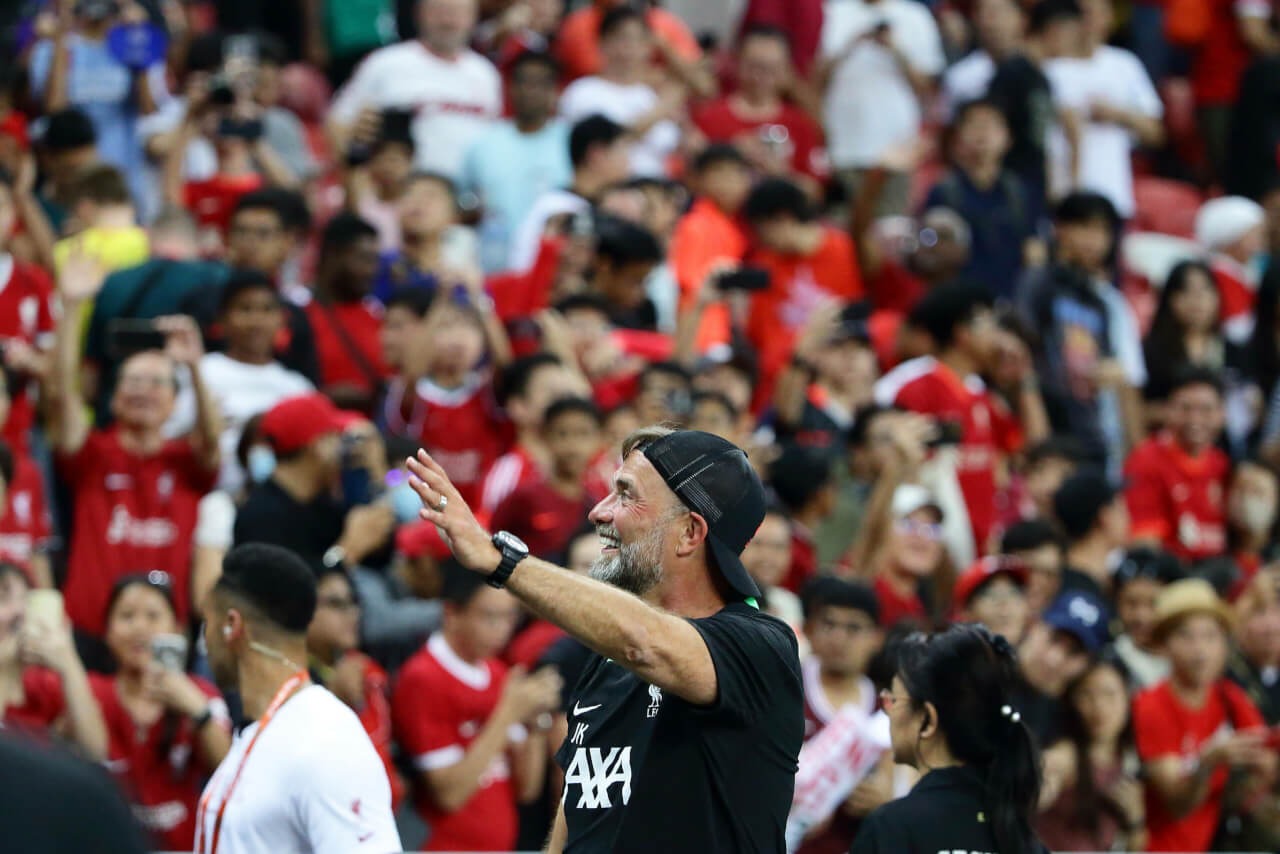
The club maintains over 300 Official Liverpool FC Supporters’ Clubs (OLSCs) spread across 100 countries. Africa and Asia represent the fastest-growing regions, driven partly by the Mohamed Salah effect in North Africa and the Middle East, and partly by commercial partnerships. Standard Chartered Bank, Liverpool’s long-standing shirt sponsor, has a heavy presence in markets like Botswana, Kenya, and Singapore — and the data shows meaningful fan growth in precisely those regions.
This is not an accident. It is the result of deliberate commercial infrastructure layered over genuine footballing success. When Liverpool won the Champions League in 2019 and the Premier League in 2020, those trophies did not just generate headlines. They generated permanent audience growth in markets where casual interest converted to sustained following.
The Revenue Flywheel
None of this would matter if it did not translate into money. It does.
Liverpool’s financial results for 2024–25 showed that the club’s total revenue was around £703 million — a record for the club and one of the highest in world football.
The club moved from a £57 million loss in the previous year to profitability, largely thanks to commercial growth directly linked to its digital reach. To be like Liverpool, visit a popular online casino and claim the best Wincraft bonuses to play your favorite games even longer and more profitably.
The club’s direct-to-consumer platform processes approximately 18 orders per second during peak periods following major victories, with the average order value 24% higher than the league average. Limited edition jerseys, autographed memorabilia, and loyalty program incentives create what marketers call “scarcity signals,” and they are extremely effective with a highly engaged audience.
This is the flywheel effect: viral content on social media increases the number of followers worldwide, which increases bargaining power when negotiating broadcast and sponsorship deals, which funds the creation of content that generates even more viral moments. Ben Latty, Liverpool’s commercial director, described the club’s “north star” as “engagement density” — the number of high-value interactions per follower, rather than simply the number of followers.
What The Competition Is Getting Wrong
The temptation for rival clubs is to chase follower numbers. More followers equals more reach equals more money — that is the logic. But Liverpool’s data suggests the equation is more nuanced.
Manchester United have 224 million followers compared to Liverpool’s 200 million. But in engagement terms, Liverpool leads the league by a massive margin. Chelsea (146 million followers) and Manchester City (159 million) both invest heavily in digital content, but neither has cracked the engagement code in the same way.
Why? One plausible explanation is authenticity. Liverpool’s content leans heavily on access — cameras in the dressing room, unscripted player interactions, the raw emotion of matchdays at Anfield. Competitors often default to slick, produced content that looks impressive but generates less emotional response. The irony is that in a world of algorithmic feeds optimised for engagement, imperfection outperforms polish.
Arsenal have shown interesting growth since 2022, riding the wave of improved results and a young, charismatic squad. But even at 108 million followers, they remain significantly behind in engagement metrics. Tottenham, despite a loyal domestic fanbase, have struggled to build comparable international digital communities.
The Arne Slot Era and What Comes Next
Under new manager Arne Slot, Liverpool’s digital story has continued to evolve. The tactical shift to a more structured, European-style 4-2-3-1 formation and the high-profile signings of Florian Wirtz (£116 million from Bayer Leverkusen) and Hugo Ekitike (£69 million) generated enormous social media interest. Wirtz’s debut content alone drove significant follower growth during the 2025 preseason.
Liverpool spent their 2025 preseason in Asia rather than North America — a deliberate choice to deepen engagement in the club’s fastest-growing digital markets. A North American preseason tour is expected for 2026, likely timed to capitalise on World Cup interest.
The club’s streaming platform, rebranded from LFCTV GO to ALL RED Video, continues to expand. Starting at $6.49 per month for U.S. subscribers, it offers full match replays, extended highlights, and exclusive documentaries. The platform serves as the club’s owned-and-operated media channel — a hedge against dependency on third-party platforms whose algorithms can shift overnight.
The Bigger Picture
What Liverpool have built is not just a social media operation. It is a media company that happens to also run a football club. That framing might sound hyperbolic, but the numbers support it: 11.9 billion video views in a single season, 1.5 billion engagements, 200 million followers, and a revenue machine generating over £700 million annually.
The lesson for the broader sports industry is straightforward but difficult to replicate. Digital audience building is not about posting more content. It is about posting the right content — the kind that makes someone in Lagos or Jakarta or São Paulo feel connected to a stadium in northwest England that they may never visit. Liverpool have figured out how to scale intimacy. That is their competitive advantage, and it will be exceedingly difficult for anyone else to catch up.
Sources: Liverpool FC Official Communications, Blinkfire Analytics, Statista, Football Ground Map, Fenway Sports Group Financial Reports. All engagement data reflects the 2023–24 and 2024–25 seasons unless otherwise noted.