
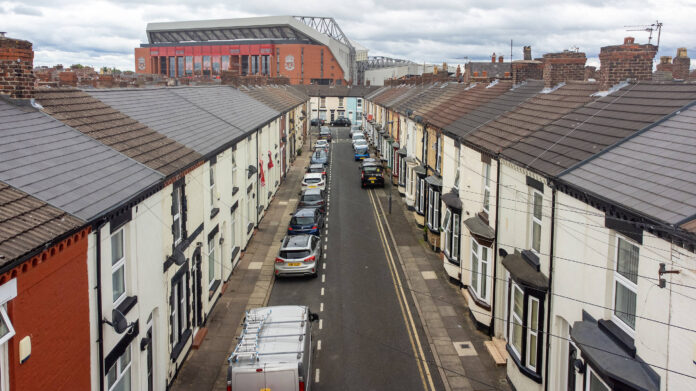

There’s a moment every matchday when the floodlights glow, You’ll Never Walk Alone rolls across the terraces, and you think: what if this was just… home?
Not a pilgrimage. Not a pricey train ride. Just stepping out your front door and walking to Anfield Stadium like it’s your local chippy.
But in 2026, what does that actually cost? And, more importantly, could a proper Red afford to be a proper local?
Liverpool: The Big Picture
Across Liverpool, the average house price now sits around £182,000.
That’s still cheaper than the areas that most Premier League clubs call home (Chelsea, we’re looking at you!) – but Anfield isn’t “average Liverpool.” It’s its own micro-market: working-class roots, heavy regeneration, investor interest, and matchday culture all wrapped into a few tight postcodes.
So, what’s on offer?
Postcode by Postcode: The Anfield Map
L4 – Anfield & Walton (The Holy Ground)
This is it. The shadow of the Main Stand. The streets where the excitement of European nights echo off terraced rows.
- Average house price: £117,500
- Typical sales cluster: £70,000–£150,000
- Terraced housing dominates
This is as “proper local” as it gets. You’re buying into history, noise, and community.
But let’s be honest – you’re also buying into a postcode that estate agents might politely call “transitional” although you’ll get a whole lot of bang for your buck.
L4 is still one of the few homes to English football where you can realistically buy a house within walking distance of a global stadium for under £150,000.
Verdict: If your dream is authenticity over aesthetics, this is the one.
L5 – Everton, Kirkdale, Vauxhall (Five minutes further out)
A short walk north and west, and you hit L5 – still close enough to feel that matchday energy but slightly removed from the immediate Anfield bubble.
- Average house price: £127,950
- Recent average sales: £132,000
- Strong growth: Around 50% between 2020-2025
L5 is where things get interesting. According to the estate agent Yopa, prices are rising faster than in L4, suggesting early-stage gentrification or investor confidence. Street by street, it varies massively though – a bit of a recurring theme in north Liverpool.
Verdict: Slightly pricier, slightly more upscale. Still very much “local,” but with one eye on the future.
L6 – Tuebrook & Fairfield (The fringe zone)
Move a little further inland and you hit L6 – not quite Anfield, but still within touching distance.
- Average house price: Around £140,000, climbing higher in parts of Fairfield
- Terraced homes: £137,000 average
- Wide postcode variation: Entry level properties will cost in the region of £60,000 – £100,000, with larger homes on more desirable streets costing in the region of £160,000 – £250,000+ and typical properties setting you back around £110,000-£140,000.
That’s not just variety – that’s a postcode split between investment stock, student lets, and larger family homes.
Verdict: Less of the romance, more practical. You won’t hear the Kop from your garden – but you might get more house for your money.
So… could you afford to be a local?
Let’s break it down like a transfer budget:
| Budget | What You Get Near Anfield |
| £70k–£100k | Entry-level terraces in L4/L6 (often needing work) |
| £100k–£130k | Solid terraces in L4/L5 – the classic “proper local” home |
| £130k–£180k | Better streets, bigger homes, L5/L6 options |
| £200k+ | Top-end terraces or semis – rare close to the ground |
Final Whistle
Here’s the truth:
With homebuyers spending an average, £268,000 on property in the UK, you can still afford to live next door to Anfield.
In fact, compared to most Premier League clubs, it’s one of the few places where that dream is still within reach and comes with the perks of one of the UK’s premier cities on the doorstep.
But – and it’s a big but – you’re buying into more than bricks and mortar. You’re buying into a postcode with edge, history, and change happening in real time.
And maybe that’s the most Liverpool thing of all.
So, would you actually do it, or should matchdays remain that hallowed pilgrimage, rather than just your normal day to day?