

Midfield concerns growing at Anfield
Liverpool can survive shortcomings at full-back for another season. They can even begin preparing for life after Mohamed Salah without ripping apart the structure that has delivered silverware in recent years. But if there is one area that demands immediate attention this summer, it is the holding midfielder role.
That is where Liverpool’s season has unravelled most dramatically.
As Gregg Evans wrote for The Athletic, “the choice to rebuild and reinforce that department carries greater weight than any other”. It is difficult to argue otherwise after watching Liverpool stumble through the closing weeks of a bruising campaign that has exposed flaws across the squad.
The most striking decline has been Alexis Mac Allister. Twelve months ago, the Argentina international looked like one of Europe’s sharpest midfield operators, snapping into challenges, controlling transitions and setting the rhythm in Liverpool’s title-winning side. This season has been altogether different.
Gregg Evans pointed to the numbers behind the regression, noting that Mac Allister “has dropped off in almost every department after playing a leading role in the title-winning campaign”. That decline has been particularly visible in defensive metrics, where the aggression and intensity that once defined his game have faded badly.
Liverpool’s defeat at Old Trafford summed up the problem. Mac Allister was directly involved in all three Manchester United goals, first turning away from a strike that deflected in, then giving possession away in the build-up to another, before failing to clear decisively for the winner. These were not isolated mistakes. They reflected a wider loss of control in Liverpool’s midfield.
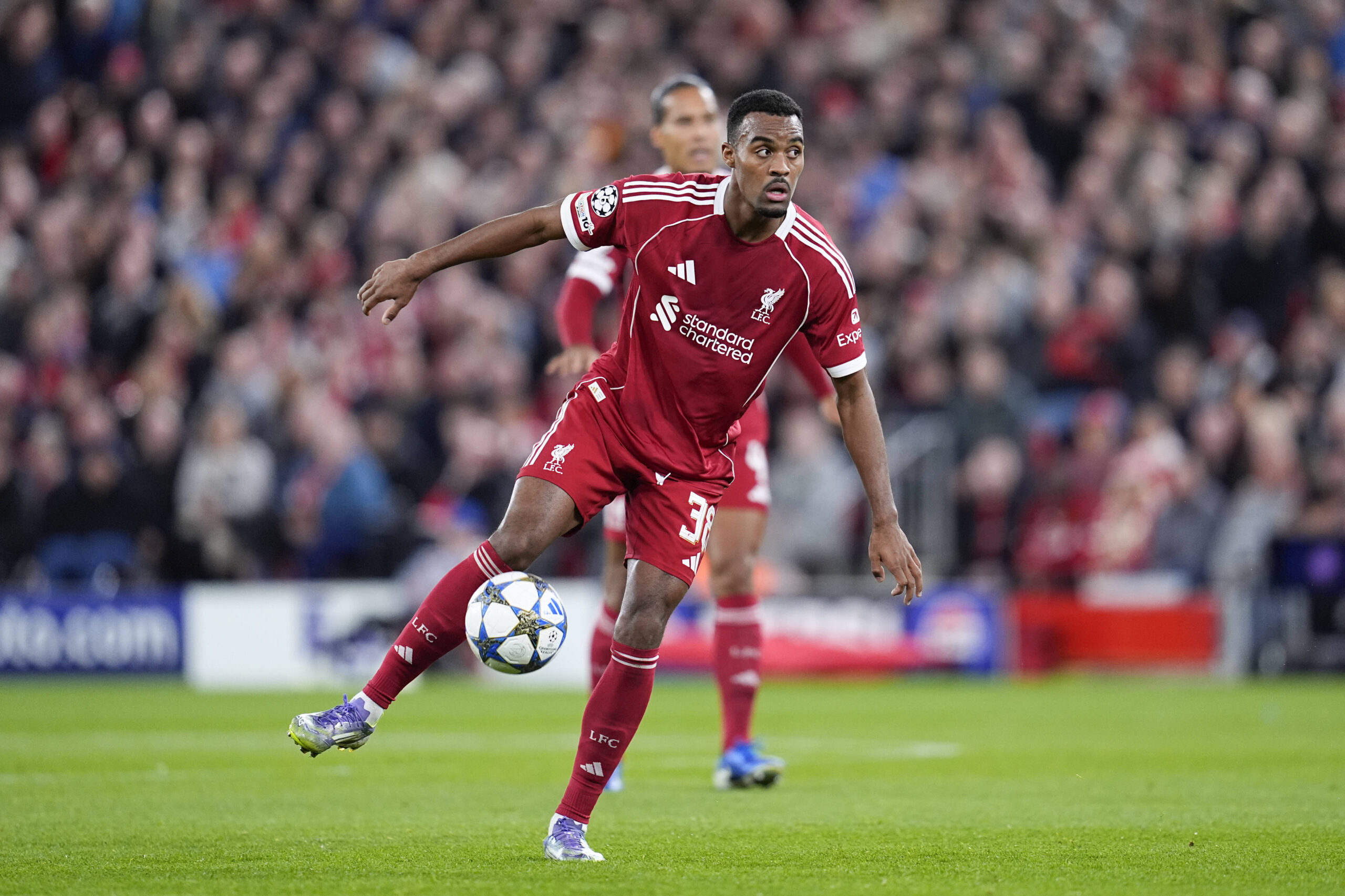
Liverpool’s alarming decline
The data only deepens the concern.
According to figures referenced by Gregg Evans, Mac Allister’s average speed and top speed have both dropped compared to previous seasons. His pressing numbers have fallen sharply too, sliding from 44.8 per game in 2023-24 to 38.1 this term.
That matters because Liverpool’s midfield once thrived on relentless pressure. Without it, the entire side becomes stretched.
Ryan Gravenberch has also suffered. Last season, Mac Allister’s energy and defensive awareness gave the Dutchman freedom to flourish in deeper positions. Now the burden has shifted the other way.
Liverpool clearly recognise Gravenberch as a long-term cornerstone after handing him a new five-year contract in March. That decision only increases the urgency around signing another holding midfielder capable of protecting the defence while driving play forward.
As Gregg Evans noted, “Liverpool still need a new midfielder who can punch the ball forward with purpose while providing the team with more defensive cover and perhaps additional height.”
Those requirements feel obvious when examining the current options. Wataru Endo is now 33 and entering the final year of his deal. Trey Nyoni remains highly talented but physically raw. Curtis Jones’ future remains uncertain. Even if Mac Allister rediscovers his best form, Liverpool lack the depth and balance needed for another title challenge.
Recruitment failures still haunting Liverpool
Liverpool’s midfield rebuild has been drifting for years.
The club missed out on Aurelien Tchouameni, then failed to land Moises Caicedo and Romeo Lavia. Martin Zubimendi also slipped away after deciding to remain with Real Sociedad before ultimately moving elsewhere.
Gregg Evans described how “that failed pursuit opened up an opportunity for Gravenberch to fill in”, and initially the gamble appeared inspired. Under Arne Slot and John Heitinga, Gravenberch adapted impressively. But Liverpool cannot continue relying on internal solutions alone.
There is also the Florian Wirtz factor. The German’s difficult first season has added further strain on the midfield unit, with Evans observing that his struggles with Premier League physicality “have impacted those operating around him”.
Liverpool’s midfield often looks lightweight, overly open and vulnerable in transition. Those weaknesses become brutally exposed against elite opposition.
The comparison with Arsenal is revealing. Declan Rice has transformed their midfield through consistency, physical dominance and leadership. Even alongside younger players, Rice provides security and authority that Liverpool currently lack in the centre of the pitch.
Liverpool need their own version of that presence.
Summer strategy must focus on balance
Finding the right holding midfielder will not be straightforward.
Elite-level options such as Rodri or Rice are unrealistic. Paris Saint-Germain’s midfielders are unattainable. Tchouameni appears settled in Madrid. Adam Wharton would command a massive fee.
That leaves Liverpool facing difficult decisions.
Sandro Tonali and Boubacar Kamara are among the names linked, though both carry risks. Kamara’s injury history is concerning, while Tonali’s situation presents complications of its own.
Still, Liverpool cannot afford hesitation.
As Gregg Evans concluded, “if a plug-and-play holding midfielder is not an option, then Liverpool may have to get creative and look for the next best thing on the market.”
That creativity could determine whether Liverpool merely recover next season or genuinely compete again at the top of English football. Midfield control remains the foundation of every great side. Right now, Liverpool simply do not have enough of it.