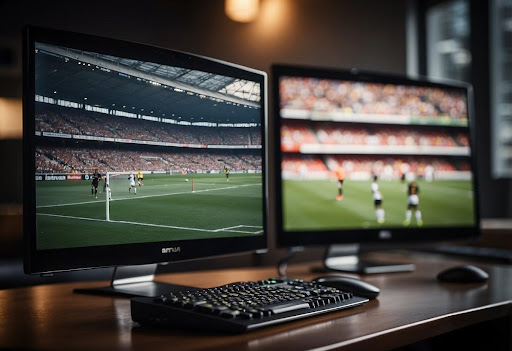

There’s a moment, just before kickoff, that every football fan knows too well. You’ve got your phone propped against a coffee cup, your laptop open on the side table, and the main event glowing from the television. Outside, the world can wait. Inside, you’re tracking three matches at once, and somehow, it feels like the only rational way to watch.
This isn’t chaos. This is modern football fandom.
The way we follow the beautiful game has changed more in the last ten years than in the previous fifty. Gone are the days of waiting for the evening highlights show or scanning the back pages for a match report printed twelve hours after the final whistle. Today’s supporter don’t just watch football. They live inside it, minute by minute, across screens and time zones and languages, connected to a global network of strangers who all feel the exact same spike of panic when a penalty is awarded.
The Rise of the Multi-Screen Fan
Ask any Premier League regular what they do during a Saturday 3pm blackout, and they won’t describe a peaceful afternoon away from the game. They’ll show you a browser with seven tabs open: live scores ticking over, a tactical stats board tracking xG and possession, a Twitter feed full of instant reactions, and at least one stream running from somewhere across the continent. For the modern fan, following a single match in isolation feels almost incomplete. You need context. You need the goal from the other ground that changes the title race. You need to know that your rival just conceded in stoppage time.
That hunger for immediate information has turned platforms like koora live into essential destinations for supporters who refuse to miss a single heartbeat of the football day. It’s no longer about catching the headlines later. It’s about being there, in the moment, when everything shifts. Whether it’s a last-minute winner in the Champions League or a shock red card in El Clásico, fans demand updates that land at the exact second the ball hits the net.
Why We Follow Everything at Once
There’s a beautiful absurdity to the modern matchday. A Barcelona fan watching El Clásico will still sneak a look at the Bayern scoreline. A Liverpool supporter celebrating a goal will immediately check if Manchester City have dropped points. We’ve become addicted to the aggregate experience—the feeling of holding the entire football universe in our palms, all at once.
This isn’t a short attention span. It’s an evolved way of loving the sport. Football has always been about storylines, but now those storylines run parallel in real time. A title race isn’t just your team’s fixtures anymore; it’s every fixture, every deflection, every questionable VAR decision from a stadium you’ve never visited. The joy comes from assembling the full picture while the paint is still wet.
For fans who want to track every kick across multiple competitions, platforms like kora live have become the silent companion to their viewing experience. You watch the main event on TV, but your phone tells you about the equalizer in Milan, the late drama in Madrid, the promotion-clinching goal in the Championship. It’s not a distraction. It’s total immersion.
The Global Football Village
The most beautiful change, though, isn’t technological. It’s human. Online football communities have turned the sport into something it’s never quite been before: a truly global conversation without borders or gatekeepers.
Ten years ago, if you wanted to talk about a midweek Champions League tie, you waited until work the next morning and hoped someone else had stayed up to watch. Now, you jump into a match thread with 3,000 people from Jakarta to Johannesburg. You share GIFs of a ridiculous nutmeg within thirty seconds of it happening. You celebrate a goal with a Colombian, a Nigerian, and a Norwegian, all of them screaming into the same digital void.
That sense of shared experience peaks during the biggest moments. A World Cup final stops the planet. A Champions League knockout night turns every living room into a stadium. And when El Clásico rolls around, the football world holds its breath together. These events aren’t just matches anymore. They’re global appointments where millions of fans, from casual followers to tactical obsessives, all point their attention at the same ninety minutes.
The New Rhythm of Football Media
What makes this era so special is that fans have stopped being passive consumers. They’re active participants in the story of the game. Live scores flash up and spark instant debate. Match statistics are pored over like sacred texts. Football news breaks on social media before official channels can even type a confirmation, and within minutes, every supporter with a push notification knows exactly what happened.
This is why the modern football fan follows multiple matches at the same time. Not because they can’t focus, but because they’ve realized that football doesn’t exist in isolation anymore. Every goal affects another table. Every upset rewrites a narrative. The joy of the sport has always been its unpredictability, but now we get to witness that unpredictability across a dozen different fronts, all at once.
Platforms like livekoora have understood this shift better than most. They’ve built spaces where fans can track the chaos without losing the emotion—where the numbers and updates serve the feeling of the game, not the other way around. Because at the end of the day, no one checks a live score for the data. They check it for hope. The dread. The sudden, explosive relief when your team snatches a winner you had no right to expect.
This Is the Beautiful Chaos
So yes, the modern matchday looks different. It’s messier. More demanding. It asks you to split your attention and trust your instincts. But it’s also richer than ever before. The fan who watches one match today is connected to every other match happening on the same afternoon. The supporter who follows live updates feels the heartbeat of the entire football world.
And when the big moments arrive—when the Champions League anthem plays, when the World Cup knockout bracket tightens, when El Clásico delivers another absurd, unforgettable night—we don’t just watch them. We share them. Instantly. Globally. Together.
That’s not a decline in how we follow the sport. It’s the most honest, emotional, beautifully chaotic way to love football that we’ve ever had. And none of us would trade it for the old days. Not even for a quiet Saturday with just one screen and no notifications.
Because football was never meant to be watched alone. And now, finally, it never has to be.