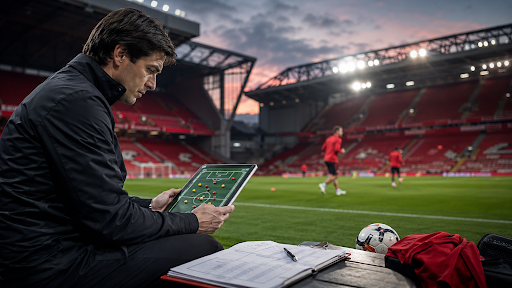
Liverpool begins a new chapter under Andoni Iraola with Champions League football still on the schedule, but there is plenty to fix. Arne Slot departed after the 2025-26 season, which ended with a fifth-place finish, just a year after guiding the club to its 20th league title. Liverpool finished on 60 points with a +10 goal difference and 12 league defeats, a noticeable step back from the standards expected at Anfield. Iraola arrives from Bournemouth after taking it to sixth place and Europe for the first time in the club’s history. That record gives Liverpool a coach with a clear pressing identity, but it also sharpens the transfer brief before July training at Kirkby.
Center-Back Cannot Wait
Center-back is the priority because Iraola’s best football depends on brave distances between the back four and midfield. Ibrahima Konaté’s exit at the end of his contract removes recovery pace, aerial presence, and a defender comfortable holding the halfway line when the press jumps. Virgil van Dijk remains the reference point, but Liverpool cannot build a 50-match season around asking a 34-year-old captain to erase every transition. The small tactical detail here is obvious: when Bournemouth pressed under Iraola, the far-side center-back often had to defend huge spaces after the ball was forced wide.
Salah’s Exit Changes the Geometry
Mohamed Salah leaving after nine years is not only a goals problem. It changes the entire right side of Liverpool’s attack, from the timing of underlaps to the way opponents defended Trent Alexander-Arnold’s old passing lane. Jeremie Frimpong can offer width and acceleration, Florian Wirtz can receive between the lines, and Hugo Ekitike gives movement across the front, but none of them replicates Salah’s old habit of pinning a left-back by standing two yards wider than expected. Liverpool needs a right-sided forward who can run beyond, finish from the inside channel, and still press the full-back after losing the ball.
The Betting Market Will Read the Press
Iraola’s arrival also changes how outsiders will price Liverpool week by week. A high press can make a side look dominant for 20 minutes, then exposed after one missed trap near the touchline, which is exactly the kind of pattern live markets react to during Premier League matches. A fan checking a betting site (Arabic: موقع مراهنات) before Liverpool’s first August fixture will likely watch team news around the center-backs, full-backs, and No.6 as closely as the headline odds. The smarter read is tactical rather than emotional: if Liverpool signs a recovery pace and a forward who triggers the press cleanly, its risk profile changes. If it does not, every turnover against Manchester City, Arsenal, or Aston Villa will feel heavier.
Full-Back Depth Needs Real Planning
Full-back depth is the less glamorous issue, but Anfield has lived through enough transition defending to know where trouble begins. Andy Robertson’s free transfer to Tottenham removed leadership, and a left-back who gave Liverpool 69 assists across his spell, while Milos Kerkez now carries a bigger week-to-week load. On the right, Frimpong’s attacking profile gives Liverpool a weapon, but Iraola will still need a defender who can close the back post when the opposite full-back advances. One loose far-post run can ruin a good hour.
Midfield Has to Run Both Ways
Liverpool’s midfield recruitment should not chase another name for the poster. It needs the legs to protect Wirtz, the judgment to cover Frimpong, and the aggression to win second balls after Ekitike or Alexander Isak contests the first pass forward. Dominik Szoboszlai, Alexis Mac Allister, Ryan Gravenberch, and Curtis Jones give Iraola different tools, but the balance changes if the press becomes more vertical than it was under Slot. The small observation from Iraola’s Bournemouth was how often the nearest midfielder jumped early to trap the pass into feet, leaving the holding player to clean up behind him.
The App Era Meets the Transfer Window
Transfer windows now play out in full view, with every medical update, shirt-number hint, and reported agent meeting dissected long before a club makes anything official. Liverpool fans will keep an eye on preseason performances, whether at Anfield, in Singapore, or on a U.S. tour if one is scheduled, but much of the attention will also stay fixed on transfer activity. Those who choose to download MelBet (Arabic: تحميل ميل بيت) before the season starts might follow football odds, outright markets, and Liverpool match lines as they watch Iraola put together his first starting lineup. The useful betting angle will lie in the details: whether Kerkez starts consecutive matches, whether Wirtz plays as a No.10 or a left-sided creator, and whether the new center-back holds the line under pressure. The transfer window will not be judged on fee size alone.
World Cup Timing Makes It Messier
The 2026 FIFA World Cup makes Liverpool’s summer harder because several senior targets and current players will be away from their club routines in June and July. Salah is with Egypt, Robertson is with Scotland after leaving, and plenty of European targets will not be doing quiet medicals while preparing for group-stage matches in North America. Liverpool’s best work may come before the tournament noise peaks or after clubs reassess injuries, minutes, and late offers in August. The Iraola era starts with a simple demand: buy players who make the press cleaner, not just players who make the announcement louder.