
Five Key Takeways From David Lynch
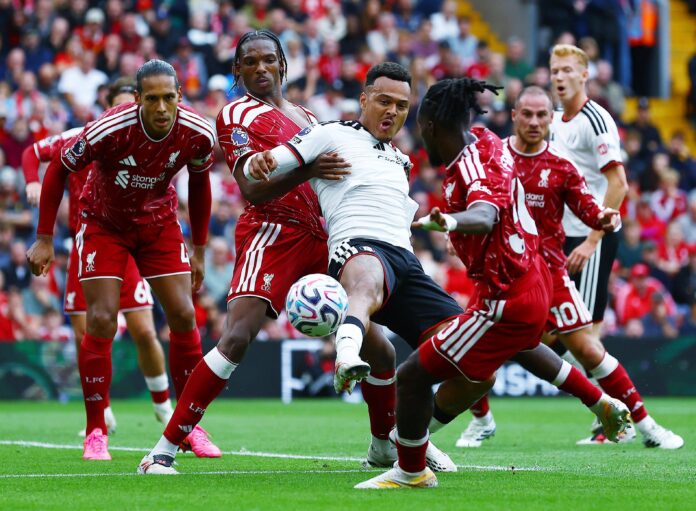
Liverpool do not get applause for drawing at home to Fulham. Nor should they. Anfield expects more than an afternoon of misplaced passes, stalled attacks and a late chance that might have disguised the shortcomings.
Yet David Lynch’s assessment of the goalless draw offered a useful distinction: disappointment does not have to become despair.
Andoni Iraola’s Liverpool are still taking shape. There are problems in midfield, questions about the depth of the squad and a pressing game that needs to survive the demands of European football. There is also a young centre-back giving everyone reason to feel better about the future.
Here are five key takeaways from Lynch’s analysis.
1. Liverpool Got the Result Their Performance Deserved
There was no great injustice here. No need to construct a story about Liverpool being denied their rightful reward.
Lynch highlighted a shot count of 14–10 in Liverpool’s favour and expected goals of 1.13 against Fulham’s 0.71. Those figures suggest a modest advantage. His reading of the game was less flattering.
Alexander Isak’s late opportunity accounted for 0.31 of Liverpool’s expected goals. Before that closing push, there had been precious little between the teams.
“I don’t think Liverpool can have any massive complaints,” Lynch said.
That is the uncomfortable starting point. Fulham earned their draw. Liverpool did too little to make the visitors feel that surviving at Anfield required something extraordinary.
Patience with a new manager is reasonable. Pretending this was a good performance would be something else.
2. Iraola Must Make His Intensity Last
The schedule is already asking difficult questions.
Liverpool played on Friday, Wednesday and Saturday. An intense Champions League encounter with Atletico Madrid was followed by a Fulham side who had enjoyed a week to prepare.
Lynch identified the challenge for Iraola: reproducing his football when recovery time is scarce.
At Bournemouth, the manager could build his approach around ferocious intensity. Liverpool’s calendar demands that he find ways to sustain it across successive matches, while making changes that preserve the team’s coherence.
Against Fulham, the energy of midweek was missing.
That does not prove the approach is doomed. Lynch pointed to Jurgen Klopp and Pep Guardiola as evidence that demanding football can survive a crowded season. Getting there, however, requires more than enthusiasm.
Iraola needs combinations that work, players who understand their responsibilities and a team capable of remaining effective when the legs are heavy. This draw exposed how much of that work remains.
3. Gravenberch and Tsimikas Missed Their Opportunity
Rotation only helps when the players coming in make their case.
Ryan Gravenberch and Kostas Tsimikas failed to do that. Lynch cited passing accuracy of 77 per cent for the midfielder and 65 per cent for the left-back. Too much possession was surrendered, sometimes with little pressure applied.
For Gravenberch, the concern extends beyond one untidy afternoon. Lynch explained that Iraola had already questioned his use of the ball against Newcastle. Careless decisions can leave Liverpool exposed before their defensive shape has recovered.
Tsimikas, meanwhile, failed to build on an encouraging cameo against Atletico. Milos Kerkez brought greater intensity after replacing him at half-time.
Neither player strengthened his claim to a regular starting place.
Still, Lynch resisted turning two poor displays into an explanation for everything. Alexis Mac Allister improved matters without fixing the entire performance. Liverpool’s problems survived the substitutions.
There is a squad to manage and a long season ahead. Writing players off is easy. Making them useful is the manager’s job.
4. Jeremy Jacquet Was Liverpool’s Outstanding Positive
On an afternoon short of distinction, Jeremy Jacquet supplied it.
Lynch named the defender Liverpool’s man of the match “by some distance”. The numbers he cited explain why: eight duels won from nine, including all five aerial contests.
Jacquet also had 97 touches, played 16 line-breaking passes and sent 13 passes into the final third.
Those figures describe a defender doing two important jobs. He stopped Fulham’s attacks and helped Liverpool move beyond the first line of pressure.
Lynch also noticed Virgil van Dijk repeatedly trusting his partner with possession. That is an encouraging sign, although any suggestion that Jacquet is already the superior distributor remains an interpretation rather than an established fact.
The clearest evidence was his performance. Alert, strong and composed, he helped ensure a poor attacking display did not become a defeat.
Liverpool’s clean sheet gave them something to build on. Jacquet was central to it.
5. Szoboszlai’s Midfield Balance Needs Attention
Dominik Szoboszlai created four chances, more than anyone else on the pitch. He also won just one of his 10 duels, according to Lynch.
That contrast captures the midfield problem.
The Hungarian can carry Liverpool’s attacking ambition, find dangerous areas and threaten goal. But a central midfielder must also make life difficult for opponents trying to run through the team.
Lynch questioned the execution of his tackling rather than his willingness to work. Getting to the contest is only part of the job.
Liverpool’s decision against strengthening midfield inevitably places greater scrutiny on those performances. Fatigue provides context. It does not remove the need for improvement.
There may also be an opening for Trey Nyoni. Lynch suggested a strong League Cup performance could push the youngster into contention under a manager willing to reward form.
Liverpool remain unbeaten, and their defending offered reassurance. The next step is to make that resilience the foundation of better football. Anfield can accept a team learning. It still needs to see the lessons taking hold.