






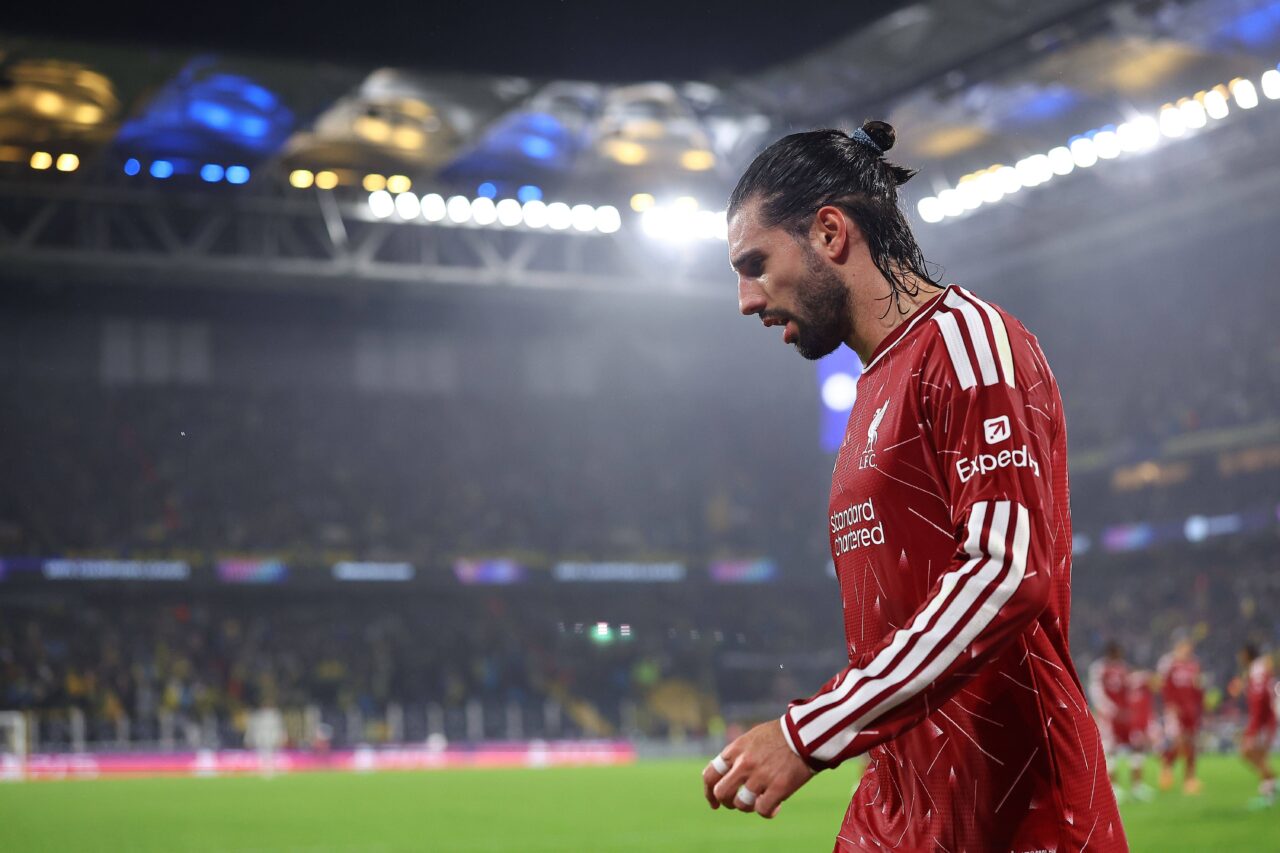
David Lynch suggests Liverpool star stupid for revealing fitness issues
David Lynch has criticised Dominik Szoboszlai’s decision to play through discomfort for Hungary and questioned why the Liverpool midfielder chose to discuss it publicly afterwards.
Speaking on Anfield Index’s Media Matters podcast, Lynch expressed concern about the potential consequences of the midfielder’s approach during an already interrupted season.
His criticism was directed at the decision rather than Szoboszlai’s character. He acknowledged the importance of representing his country, particularly as captain, but argued that the player also needed to consider his availability for Liverpool.
Szoboszlai admission raises fresh concerns
The discussion followed Szoboszlai’s account of his preparation for Hungary’s Nations League match against Georgia.
The midfielder said he had nearly withdrawn during the warm-up after feeling discomfort when shooting. He nevertheless decided to play, completed 90 minutes and provided an assist.
In comments read out during the podcast, Szoboszlai explained: “I felt the injury during one of my shots, but I thought to myself, having come this far, I wasn’t going to let the team down.”
For Lynch, that explanation raised questions about whether determination had overtaken good judgement.
“I think there’s no other way to describe this than stupid, really,” he said.
His concern extended beyond whether Szoboszlai could finish that particular match. He feared that playing through symptoms could lead to a more significant absence, although the discussion did not establish a medical diagnosis or confirm any new injury.
Public comments add another complication
Lynch also questioned the wisdom of publicly describing the discomfort after choosing to continue.
“He could have been a little bit smarter in terms of either not playing the game or, if you’re going to play through the pain in that way, maybe don’t talk about it,” he said.
“I don’t think Liverpool supporters are going to like it that you’re prioritising to such a degree.”
That criticism was accompanied by recognition of Szoboszlai’s international responsibilities.
“Playing for your country is a massive honour, and particularly when you are the captain, absolutely understand that. Don’t want to play that down at all.”
The tension, in Lynch’s view, was between that understandable commitment and the need to return ready for the club fixtures that follow.
Liverpool need available midfield options
Szoboszlai’s recent fitness difficulties make the situation particularly sensitive.
The midfielder has already experienced hamstring problems this season, including a disrupted return against Brentford. Liverpool therefore have reason to pay close attention to how he manages another demanding period.
Lynch stressed that the debate about Liverpool’s strongest midfield should not obscure their need for several reliable options.
“Even if Iraola settles on [Trey Nyoni], he can’t play every game. And Alexis Mac Allister can’t play every game,” he said.
“Liverpool absolutely need Gravenberch. And they need Szoboszlai to be in form.”
Availability is a prerequisite for achieving that form. With matches arriving frequently, Liverpool cannot place every responsibility on whichever partnership currently appears most convincing.
Selection competition increases the stakes
Lynch also suggested that an extended absence could complicate Szoboszlai’s efforts to establish himself in Iraola’s preferred midfield.
“If he disappears for a couple of months due to an injury he picks up on international duty, I think he’s going to seriously struggle to get back in the team,” he said.
That was a hypothetical warning, not a prediction that Szoboszlai would miss that amount of football.
Lynch identified Nyoni’s suitability for the deeper role as a particular factor, arguing that the teenager currently looks a more natural fit.
The immediate priority remains simpler than the selection debate: Liverpool need Szoboszlai to return without another setback. His willingness to play is unquestionable. Lynch’s criticism concerns whether exercising greater restraint would better serve both player and club.